
Project Overview
| Project Name | The Climate Innovation Center |
| Certification Type | Zero Carbon + Zero Energy Dual Certification |
| Location | Salt Lake City, Utah |
| Typology | Existing Building |
| Start of Occupancy | 06/01/2024 |
| Owner Occupied | Utah Clean Energy |
| Occupancy Type | Commercial |
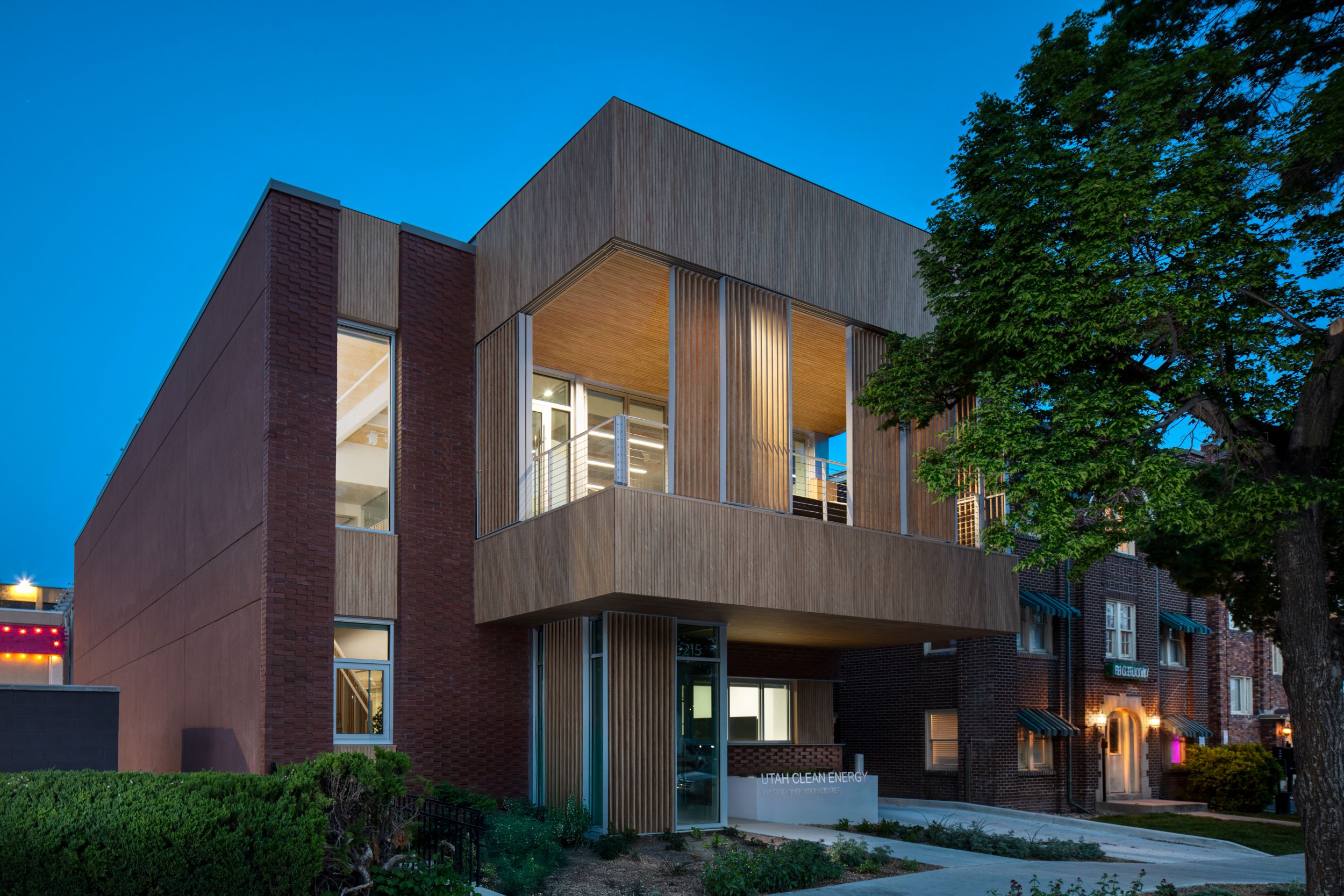
Photo Credit: Paul Richer
The Climate Innovation Center serves as the office for Utah Clean Energy, a mission-driven non-profit organization headquartered in Salt Lake City, Utah. The Center is also a showcase building, demonstrating that it is possible today to design and build homes and buildings that are pollution-free, healthy, comfortable, and beautiful. The adaptive-reuse building is 2-stories with gross floor area of 5,620 square feet. The Center features a well-insulated and airtight building envelope, a VRF heat pump mechanical system with a DOAS that features an EVR. The grid-connected building is solar powered, and includes battery storage, heat pump water heating, induction cooking, EV charging, water-wise landscaping and fixtures. It also features numerous low-carbon construction and finish materials from mass timber, reclaimed and salvaged wood, as well as highly recycled and bio-based materials.
Learn more: https://climateinnovationcenter.org.
Project Team
| Owner | Utah Clean Energy |
| General Contractor | Okland Construction |
| Architects | Blalock & Partners |
| Plumbing Engineer | Reliable |
| Mechanical Engineer | VBFA |
| Civil Engineer | Forsgren |
| Electrical Engineer | BNA |
| Landscape Architect | G. Brown |
| Building Envelope Commissioning Agent | Stantec |
| Systems Commissioning Agent | ENFRA |
| Solar Design | Gardner Energy |
Early Design Process
The owner (Utah Clean Energy) selected the architectural firm because they shared the organization’s vision for a super-efficient, all-electric, emission-free and Zero Energy certified showcase building and because they had experience with other “net zero” projects. Before selecting the architect, the owner made the decision to pursue Zero Energy certification and ENERGY STAR certification and added these certifications as part of the Owner’s Project Requirements document. These certifications were prioritized since they are performance based and focus on eliminating operational emissions through energy efficient construction, all-electric equipment and appliances, and being powered with clean energy. From the beginning of the project and throughout design and construction, Utah Clean Energy staff communicated to the entire project team that Zero Energy certification was a fundamental requirement of the project. Along with a supportive and aligned architect, the mechanical engineer, general contractor, and other project partners accepted the vision for our project from the get-go.
Minor misgivings were expressed by some subcontractors involved in the mechanical system installation, wall assembly construction details and window installation details but were addressed with assistance from the architect, system commissioning agent, and building envelope commissioning agent. After occupancy, Utah Clean Energy staff made the decision to apply for Zero Carbon certification, given their attention to adaptive re-use, using salvaged material, , and selecting low embodied carbon materials throughout the design and construction process.
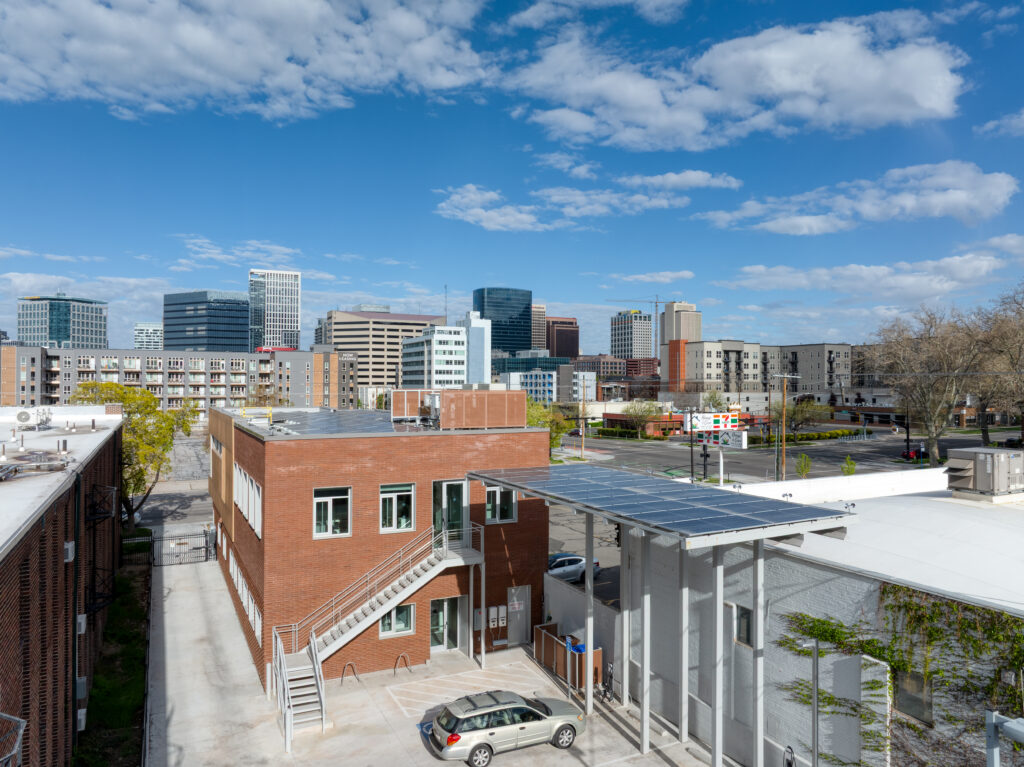
Photo Credit: Paul Richer
Construction
The requirements for Zero Energy certification and ENERGY STAR certification were incorporated into the Owner’s Project Requirements document. This document was shared with core construction partners, including the mechanical engineer, electrical engineer, general contractor, system commissioning agent, building envelope commissioning agent, and others early in the design process.
At the early design phase, Utah Clean Energy staff met weekly with the architect and mechanical engineer/energy modeler to evaluate the energy efficiency and cost impacts various design decisions. At the direction of the owner and architect, the energy modeler ran numerous iterations of the model to compare the energy and cost impacts of several mechanical system types, wall and roof insulation levels, glazing performance levels, and lighting power density. This process helped the owner select the mechanical system, wall and roof insulation levels, glazing performance levels, and lighting power density levels to meet an EUI target of 28.
This EUI target was selected based on the 2021 IECC Appendix CC Zero Energy Commercial Building Provisions. The estimated annual electricity consumption from the energy model helped identify the amount of solar PV that needed to be installed to generate more than 100% of our estimated annual electricity consumption with on-site solar energy.
The team also prioritized construction and finish materials that have low embodied carbon throughout the process, but the Utah Clean Energy team didn’t analyze the embodied carbon of the project until occupancy. The owners met weekly with the architect and the general contractor to check in on construction progress to meet the ZE requirements and discussed any additional direction that subcontractors required.
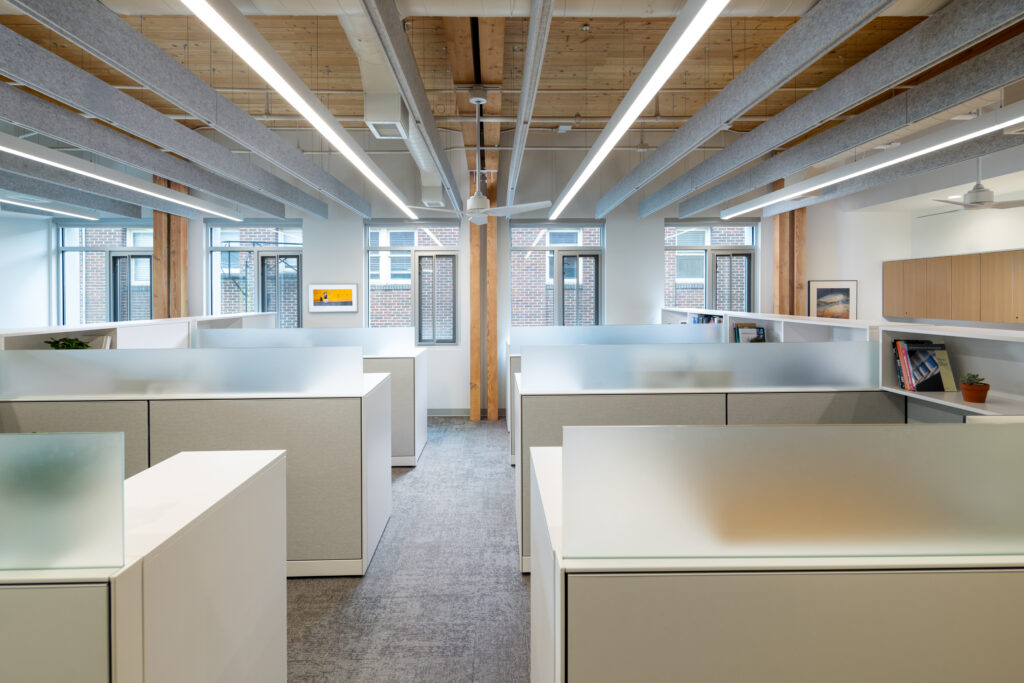
Photo Credit: Paul Richer
](https://living-future.org/wp-content/uploads/2026/06/20250420_blalock_uce_25_2-683x1024.jpg "default - Living Future")
Photo Credit: Paul Richer
Lessons Learned
During the energy modeling phase for the Climate Innovation Center, the oil recovery process associated with the VRF mechanical system was not fully understood or accurately accounted for. As a result, the model did not anticipate short-duration demand spikes caused by oil recovery operation. In the first winter of occupancy, these spikes, each lasting less than three minutes, were sufficient for the utility to reclassify the building to a higher rate schedule, increasing utility bill costs significantly. This experience underscored the importance of fully understanding and modeling the VRF system, including oil recovery, and evaluating the peak kW demand impacts of different scenarios. For example, after the fact, the owners realized that they may have avoided these large demand spikes and unintended utility rate consequences if the outdoor VRF condenser units had been separated to avoid simultaneous oil recovery.
Another key lesson learned with the VRF system is that it is best to “set it and forget it” when it comes to settings. VRF systems do not operate as efficiently when the building temperatures are “set back” during the nighttime and weekends, as they typically require more time to return a space to setpoint than traditional systems. When the system is allowed to drift and then forced to recover, demand can peak significantly as the system ramps up to regain temperature. Proper controls strategies, occupant expectations, and operational practices are essential to avoid unnecessary demand spikes and ensure the system operates as intended.
The solar PV system has demonstrated highly consistent and predictable performance, reinforcing its value as a reliable energy resource. However, this experience also highlighted the importance of establishing an operations and maintenance (O&M) plan at the time of commissioning to ensure long-term performance is sustained. By contrast, the battery system has had some limitations. It has not been able to reliably shave short-duration demand spikes. In addition, the project underscored that battery use cases, such as peak shaving, energy arbitrage, and resilience, are not always complementary. Early clarity around priorities, performance expectations, and monitoring strategies is critical to realizing the intended benefits of battery storage.
A final lesson learned was that calculating embodied carbon is easiest when integrated early in the design process, as it enables teams to make informed material decisions when influence is greatest. For the Climate Innovation Center, using Athena highlighted the importance of clearly defined material quantity data, requiring design teams to report information in terms of material volumes. Complete Revit models with embedded material attributes proved especially valuable, as they could be uploaded directly into tools like Athena, simplifying the process. The project also reinforced that reusing existing structures or materials is one of the most impactful strategies for reducing embodied carbon and supporting Zero Carbon certification, emphasizing the value of preservation and reuse alongside new construction decisions.

Photo Credit: Paul Richer