
Project Overview
| Project Name | 300 Kansas |
| Certification Type | Zero Carbon 1.0 |
| Location | San Francisco, CA, USA |
| Typology | Core & Shell R&D and Advanced Manufacturing Facility |
| Area | 150,000 square feet |
| Start of Occupancy | Unoccupided |
| Occupancy Type | Core and Shell Lab – Office |
| Occupancy | Core and Shell – 2 Overall – 417 |
Photograph courtesy of Jason O’Rear
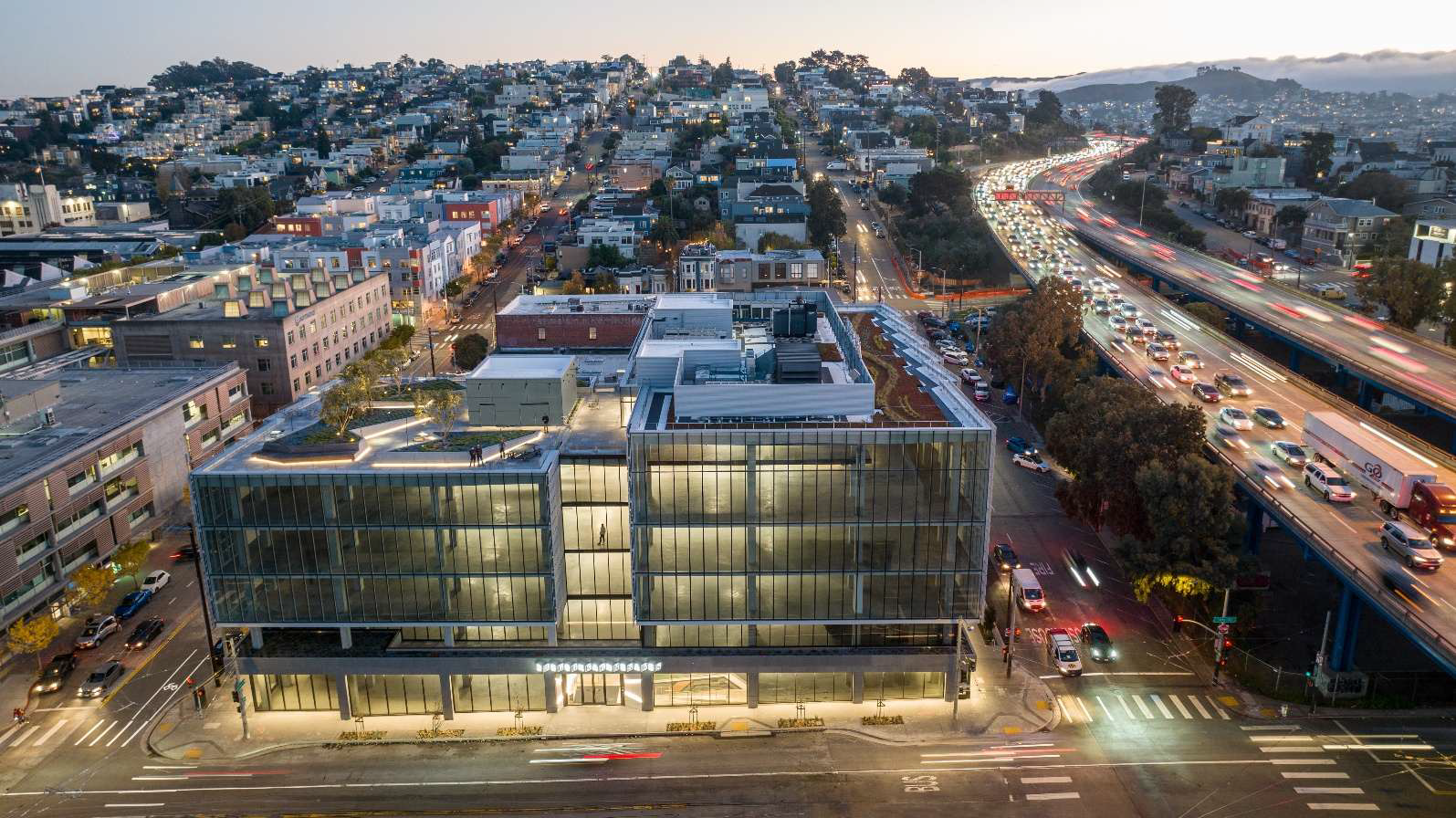
The 27,500-square-foot site is situated at 16th and Kansas (Assessor’s Block 3958, Lot 006. To make way for the new structure, the existing one-story building was demolished. Located in the heart of San Francisco’s Design District, this project features a six-story, 137,000-square-foot core and shell building.
The new building sits atop a basement level primarily utilized for parking. It is intended for light manufacturing and laboratory tenants.
Project Team
| Owner | Spear Street Capital |
| General Contractor | WebCor |
| Design Architect | El Dorado |
| Architect of Record | Form4 |
| Mechanical Engineer | PAE |
| Civil Engineer | BKF |
| Mechanical Engineer | PAE |
| Electrical Engineer | PAE |
| Structural Engineer | KPFF |
| Landscape Architect | Groundworks Office |
| Certification Consultant | Atelier Ten |
Early Design Process
The project team for 300 Kansas Street was assembled with Spear Street Capital serving as the developer and Atelier Ten engaged as a key sustainability and building performance consultant, alongside an established group of design and engineering consultants already involved in the project. From the beginning, the team was working toward a high-performance building that included an all-electric design and a LEED Gold target. However, ILFI Zero Carbon Core & Shell certification was not an initial project goal and was considered after the design process was already underway.
ILFI’s Zero Carbon certification was first discussed when the project team began considering how to build upon the project’s existing sustainability goals. Atelier Ten expressed early interest in pursuing Zero Carbon certification because it is a performance-based standard that requires ongoing verification of building performance beyond design and construction. At the same time, Spear Street Capital had recently completed a project in Seattle known as the Watershed, which had achieved ILFI Living Building Petal Certification. During the leasing and sale of that project, Spear Street Capital observed that the market responded positively to the building’s sustainability attributes, including higher lease rates and increased asset value.
Drawing on this prior experience, Spear Street Capital raised the possibility of pursuing ILFI Zero Carbon Core & Shell certification at 300 Kansas Street. This experience helped inform the decision to pursue a more ambitious sustainability strategy beyond LEED Gold, despite the fact that the Zero Carbon Core & Shell program was a pilot program that had not yet been pursued by other projects.
Once both Spear Street Capital and Atelier Ten recognized their shared interest in Zero Carbon certification, Atelier Ten conducted a comprehensive feasibility study. The purpose of this study was to ensure that all consultants understood the specific requirements, documentation expectations, and performance obligations associated with the certification. Because the design process was already in progress, this effort involved reviewing previously proposed design options and identifying small, cost-effective adjustments that would allow the project to meet the Zero Carbon criteria.
The decision to pursue ILFI Zero Carbon Core & Shell certification was based on the results of this feasibility analysis and the alignment between the developer’s sustainability ambitions and the consultant team’s technical understanding of the The decision to pursue ILFI Zero Carbon Core & Shell certification was based on the results of this feasibility analysis and the alignment between the developer’s sustainability ambitions and the consultant team’s technical understanding of the standard. Following this decision, the certification requirements and associated expectations were communicated to the broader consultant team through continued coordination and discussion, allowing the project to move forward with a clear understanding of the goals and constraints associated with Zero Carbon certification.

Photograph courtesy of Jason O’Rear
Occupancy
The most significant challenge encountered during the performance period was that the building remained entirely unoccupied by tenants, despite the original plan for immediate post-construction occupancy. This discrepancy rendered the initial whole-building energy model inaccurate, as the only occupants were building management staff utilizing the Core and Shell portions. To overcome this, the team performed a rigorous calibration of the energy model using eQUEST to isolate common space zones and establish a logical EUI target based on actual, rather than theoretical, usage. Site investigations revealed operational inefficiencies, such as Fan Coil Units (FCUs) running 24/7 at maximum speed with setpoints as low as 68°F and the Dedicated Outdoor Air System (DOAS) running without a load. The team corrected these issues by adjusting setpoints and providing direct instructions to facility management to align operations with the design intent, a process finalized in April 2024.
The primary lesson learned is the necessity of bridging the gap between design assumptions and real-world facility management through active, site-specific monitoring. Since the lack of a “usual” occupancy pattern created a risk for high energy waste, the project demonstrated that an ILFI-oriented performance goal requires a more granular, zone-based approach to modeling that can adapt to delayed tenant move-ins. Future projects will benefit from establishing clearer communication channels with facility staff early in the performance period to ensure that systems like the DOAS are not left running in vacant spaces. This experience underscores that occupant behavior—or the lack thereof—must be met with flexible operational strategies and frequent site audits to ensure the building performs as efficiently as intended under any occupancy scenario.

Photograph courtesy of Jason O’Rear
Lessons Learned
Several lessons emerged from the pursuit of Zero Carbon Core & Shell certification at 300 Kansas Street, particularly regarding timing, coordination, and documentation. One key lesson was the importance of early discussions around certification goals. Although the project ultimately achieved certification, the design process was already underway when Zero Carbon was introduced. This required the team to revisit proposed design options and navigate additional coordination among consultants. Earlier alignment may have reduced the need for later adjustments and feasibility analysis.
The project demonstrated the value of having sustainability expertise embedded within the design team. Atelier Ten’s early interest in Zero Carbon certification and their ability to conduct a detailed feasibility study helped clarify requirements and manage expectations across the consultant team. This process ensured that all parties understood the performance-based nature of the certification and the need for ongoing verification beyond construction.
Another lesson relates to documentation and tenant-facing materials. The development of a Tenant Sustainability Guide and a “kit of parts” proved essential in supporting certification requirements during tenant buildout and operations. These tools helped translate base-building sustainability strategies into actionable guidance for tenants, reinforcing the importance of clear, accessible documentation.
The project team also learned that early material decisions can significantly reduce later costs and complexity. Because low-GWP materials such as recycled concrete mixes were already specified, the upfront costs associated with Zero Carbon certification were minimal, and no major design changes were required.