
Project Overview
| Project Name | Fort Totten Alternative CTE School |
| Certification Type | Zero Energy |
| Location | Fort Totten, North Dakota |
| Typology | New Building |
| Start of Occupancy | 08/31/2017 |
| Occupancy Type | Education |
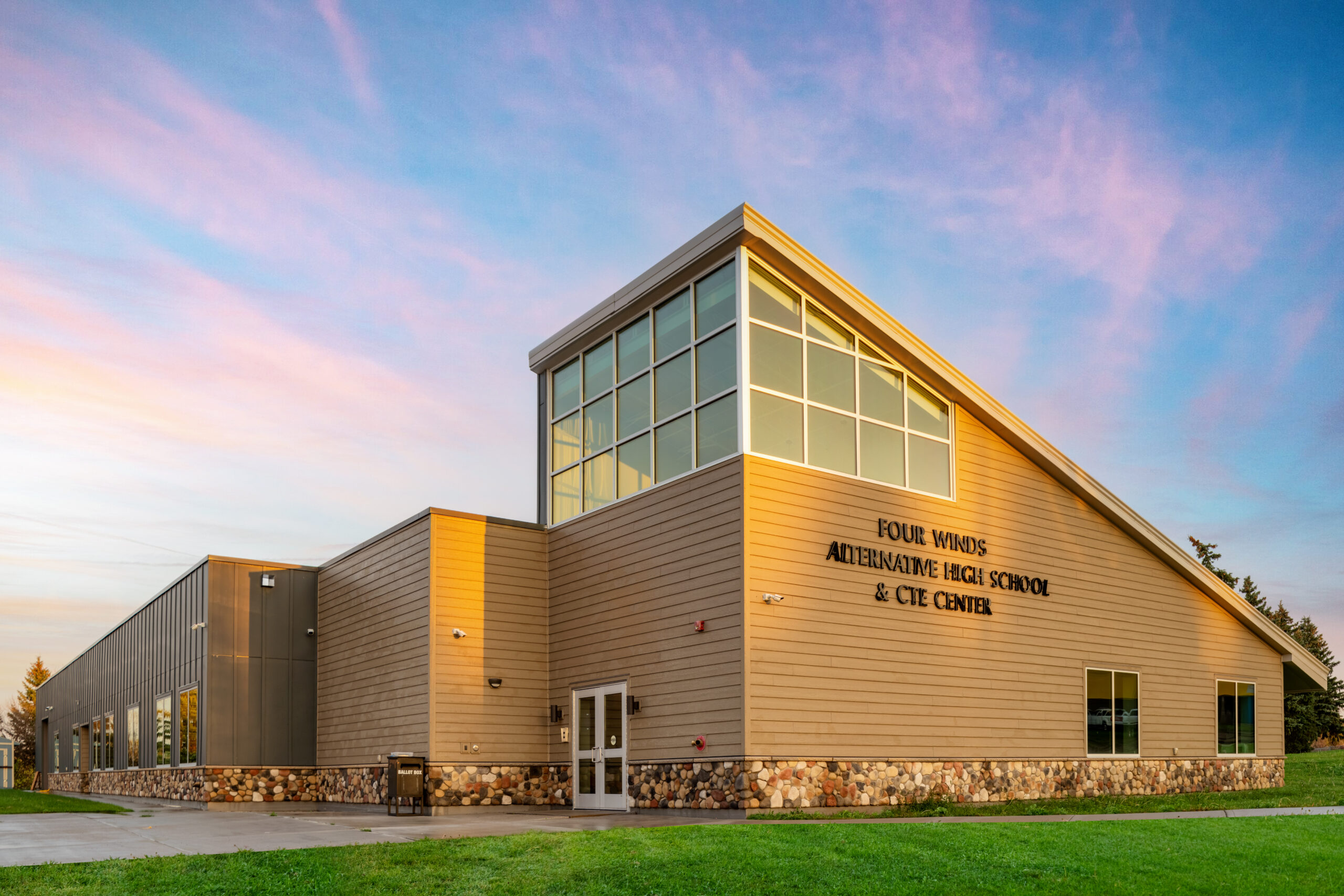
Photo Credit: Dangerbird Productions
Four Winds Alternative and CTE High School, located in Fort Totten, ND on the Spirit Lake Reservation, is the first school designed to be net zero on tribal land in the country. There are several features that contribute to its energy efficiency including: photovoltaic (solar) panels, a ground-source geothermal heating and cooling system, high-efficiency water-to-air heat pumps, energy recovery system for free heating and cooling, variable-speed fans and pumps to minimize excess energy use, occupancy sensors for demand-based lighting, LED lighting, solar tubes for free lighting, specially insulated walls and roof, and triple pane windows.
Project Team
| Owner | Fort Totten School District |
| General Contractor | Shingobee Builders |
| Architects | DSGW Architecture |
| MEP Engineer | CMTA |
| Civil Engineer | Northern Engineering & Consulting, Inc. |
| Mechanical & Plumbing Contractor | Klemetsrud Plumbing & Heating |
| Electrical Contractor | Bergstrom Electric |
| Interior Design | DSGW Architecture |
| Structural Engineer | Heyer Engineering |
Advice
When advising design teams considering Zero Energy certification for a school on tribal land, the most critical guidance is to shift from a purely technical mindset to one of deep community integration. Net Zero Energy (NZE) architecture in this context is not just an engineering goal; it is an exercise in sovereignty, cultural preservation, and long-term community resilience. Design teams must also understand that many Tribes are sovereign Nations and that negotiating on their behalf with the electrical utility should not be unilateral, but give the Tribe the opportunity to negotiate on behalf of their own interests which may have different goals than a normal school board / leadership may have. Many utilities do not have good relationships with Tribes, so being an advocate and fighting for your clients might need to be added to your services.
First and foremost, teams must co-create the project with the community from day one. Successful zero energy design requires weaving cultural values, ecological stewardship, and local traditions directly into the building’s identity. This means engaging tribal elders, educators, and community members in visioning sessions to ensure the school serves as a true community hub. When the community sees their heritage and values reflected in the architecture, they take profound ownership of the facility, which is vital for the building’s long-term operational success.
Second, goal setting and Energy Use Intensity (EUI) targets must be established early and aligned with local realities. Teams should balance national zero-energy benchmarks with the specific regional climate and available tribal resources. It is essential to include facility managers and maintenance staff in these early conversations. Designing a complex, hyper-efficient system that cannot be easily serviced locally defeats the purpose of sustainable design. Instead, teams should prioritize rugged, highly efficient mechanical systems and an exceptionally robust thermal envelope. This ensures the building remains resilient and manageable within regional operational constraints.
Furthermore, teams must treat the net-zero infrastructure as a fragile “ecosystem” that requires strict protection during construction. Lessons learned from successful projects highlight the absolute necessity of educating the general contractor and subcontractors. Holding specialized pre-construction workshops ensures that the construction team understands how minor field adjustments—like a compromised air barrier or an unapproved material substitution—can completely disrupt the tight energy budget required for certification. Fostering this shared accountability transforms contractors from simple builders into active guardians of the school’s energy performance.
Finally, early and intensive energy modeling must be paired with continuous post-occupancy training. A zero energy school relies heavily on human behavior and active energy management. By viewing the project not merely as an environmental milestone, but as a multigenerational investment in tribal self-reliance and community education, teams can deliver a repeatable framework that empowers the community for decades to come.

Photo Credit: Dangerbird Productions
Lessons Learned
When analyzing the successful implementation of a Net Zero Energy (NZE) school, project teams consistently find that the transition from a design blueprint to a fully operational facility hinges on a deep understanding of the building as a delicate, interconnected ecosystem. One of the most critical lessons learned is that achieving zero energy certification is not purely an engineering or architectural challenge; it is a construction and execution challenge. A net-zero building operates on an incredibly tight energy budget where every component—from the continuous air barrier and high-performance thermal envelope to the geothermal wells and sophisticated HVAC controls—relies on the precise performance of the others. If one element fails or is improperly installed, the entire energy balance is disrupted, jeopardizing the building’s ability to offset its loads with on-site renewable generation.
Consequently, a foundational lesson at the beginning of a project is the absolute necessity of intensive contractor and subcontractor education. Traditionally, subcontractors operate in silos, focusing solely on their specific trade. For an NZE school to succeed, however, the construction team must be educated to view the project through a holistic lens. Project teams have learned that holding specialized pre-construction workshops and continuous, hands-on field orientations is vital. During these sessions, contractors are shown exactly how minor, seemingly inconsequential field adjustments—such as a poorly sealed penetration, a slight gap in insulation, or an unapproved material substitution—can create thermal bridges or air leaks that completely compromise the Energy Use Intensity (EUI) targets.
Furthermore, fostering shared accountability across all trades transforms the workforce from general builders into active guardians of the net-zero ecosystem. When a drywaller understands how their work affects the air barrier, or when an electrician realizes how a box installation impacts thermal performance, quality control improves exponentially. Ultimately, the lesson is clear: design excellence must be matched by construction literacy. By investing time early to educate the contractor on the “why” behind stringent net-zero specifications, project teams secure the meticulous craftsmanship required to turn an ambitious environmental vision into a high-performing, resilient reality.
As we continue to monitor this building, our actual EUI is performing better than the design EUI and that goes to show to partnership between all trades didn’t go unnoticed and everyone should be proud to have worked on this project. “The energy performance of this school is a bit surreal….from my research, it is one of the best if not THE BEST performing school EUI in the country!” – David Vig, CMTA.

Photo Credit: DSGW Architecture
Other Insights
In 2014, a pivotal moment in educational design unfolded during a tour of a pioneering Net Zero Energy (NZE) elementary school in Kentucky, Richardsville Elementary School. Walking through the facility, the design team witnessed firsthand how a building could move beyond mere efficiency to become a self-sustaining ecosystem. Richardsville Elementary demonstrated that achieving net-zero status required a seamless integration of a high-performance thermal envelope, geothermal HVAC systems, and a robust solar array. However, the most profound lesson learned from the school tour was not about the technology itself, but about the critical role of human behavior and operational clarity. The school’s success relied heavily on active energy management and an engaged administration, proving that a net-zero building must be designed to operate intuitively for its end users.
This foundational insight heavily informed the approach taken years later at Fort Totten. Recognizing that a school on tribal land faces unique geographic and resource realities, the team translated the Richardsville Elementary lessons into a strategy tailored for the local climate and community context. At Fort Totten, the design prioritized rugged, low-maintenance, and highly efficient mechanical systems coupled with an exceptionally airtight envelope. The team understood that the building’s net-zero “ecosystem” is fragile; even minor on-site construction deviations or unapproved material substitutions could jeopardize the tight energy budget. Therefore, extensive pre-construction workshops were held to educate the general contractor and subcontractors, ensuring the entire construction team understood how individual components directly impacted the overall Energy Use Intensity (EUI).
Moving forward, several key lessons learned from the Fort Totten project are being shared to help other communities replicate this sustainable model successfully. First, early and intensive energy modeling must be paired with genuine community visioning; co-creating the school ensures that cultural values, ecological stewardship, and operational realities are balanced from day one. Second, setting aggressive yet realistic EUI targets must involve both tribal elders and facility managers to ensure long-term sovereignty and self-reliance. Finally, educating the construction team and establishing clear, post-occupancy training for staff guarantees that the building continues to perform as intended. By sharing these strategies, the model transforms from a single isolated project into a repeatable framework for generational resilience and community-centered education.

Photo Credit: DSGW Architecture