

Project Overview
| Project Name | Humanscale Chicago |
| Certification Type | Petal Certified |
| Location | Chicago, IL |
| Typology | Interior, Commercial |
| Start of Occupancy | 05/14/2024 |
| Owner Occupied | Humanscale |
| Occupancy Type | Retail, Showroom |
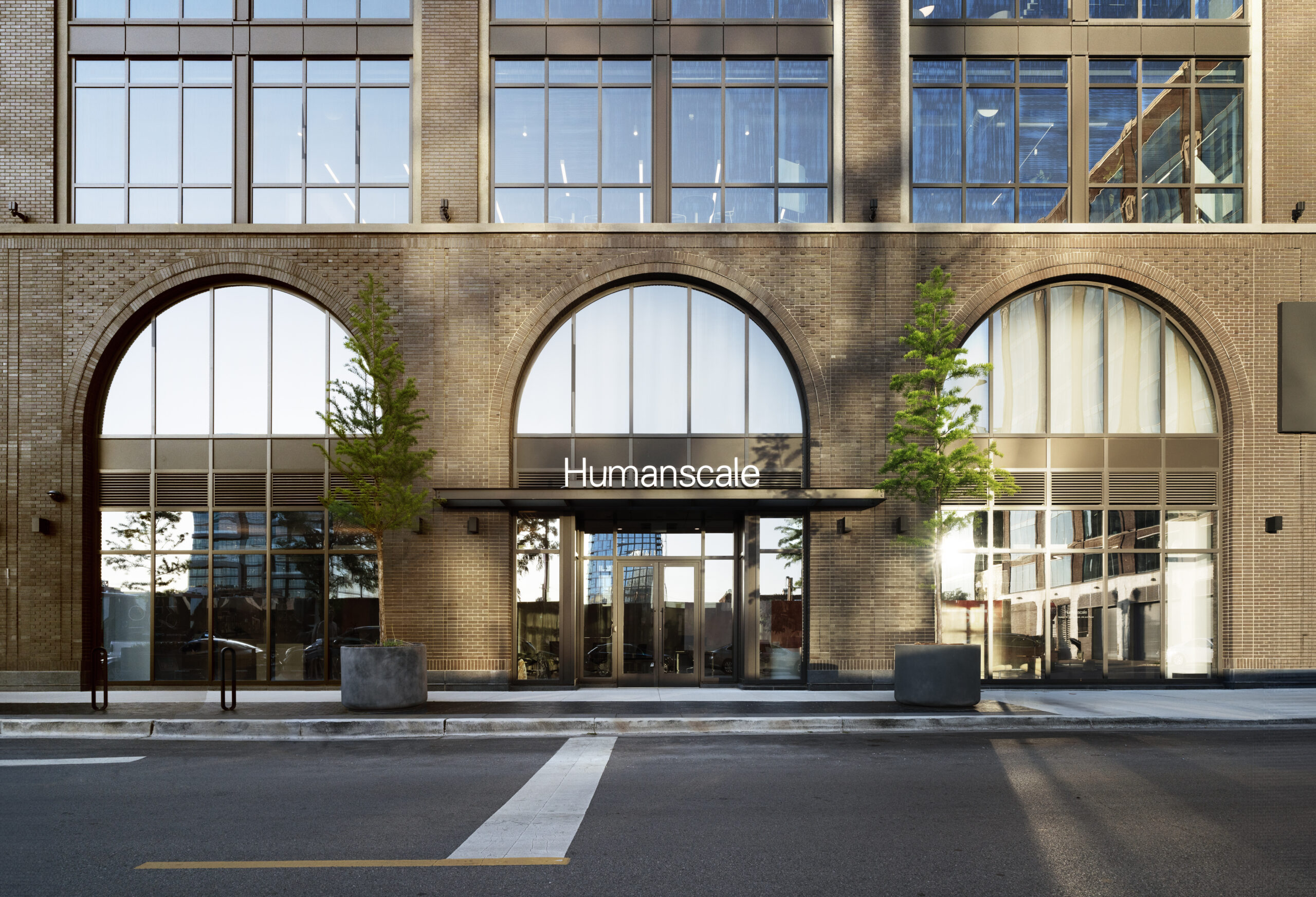
Photo Credit: Humanscale
Humanscale is the leading designer and manufacturer of ergonomic products that improve the health and comfort of work life. Humanscale completed construction on a new 4,000 square foot showroom in the Fulton Market neighborhood of Chicago, Illinois in 2024. The showroom is a retail store located at ground level and accessible from the public sidewalk. The space features Humanscale’s product lines, provides a touch down space for their local sales team, and is equipped with state-of-the-art technology to host large educational industry events.
Project Team
| Owner | Humanscale |
| General Contractor | CDI Construction Group, Inc. |
| Architects | Reddymade / bKL Architecture LLC |
| MEP Engineer | Interface Engineering, Inc. |
| Structural Engineer | WSP USA |
| Lighting Design | Hugh Lighting Design |
| Certification Consultant | The Sheward Partnership, LLC |
Early Design Process
Humanscale has a long history of working with Living Futures and an equally long list of “firsts.” In 2016, Humanscale was the first manufacturer to achieve the full Living Product Challenge certification for any product; published the first JUST label in the furniture industry; and published the first 3rd Party Verified Declare labels. The Living Product Challenge inspired updates across Humanscale’s manufacturing facilities, including on-site solar, rainwater harvesting for process water use, and diverting more than 90% of waste from landfills. Humanscale is the only major brand in the commercial furniture industry in the US to become B Corp certified, and is a signatory to the Science Based Targets initiative (SBTi).
Humanscale made the ambitious commitment to pursue Living Building Challenge Petal certification for the Chicago showroom because the certification supported their corporate social responsibility program and aligned with their robust product certifications. Humanscale’s products contribute to the Living Building Challenge Petal certification in the following ways: FSC certification, 3rd Party Verified Declare labels, local manufacture, low VOC emission CDPH testing, and biophilic design inspiration. For example, Imperative 14 Responsible Sourcing only required 4 Declare labeled products due to the small size of the interior fit-out project but the project achieved 42 Declare labeled products, many of which are Humanscale’s furniture offerings.
Humanscale chose to pursue Living Building Challenge Petal certification early in schematic design. They engaged a dedicated sustainability consultant to manage the process. The Design and Construction Team had experience with LEED and were familiar with third-party green building certifications. The simplified palette and energy-related systems streamlined materials research.
Humanscale chose to pursue Design for Freedom Pilot Project recognition at the beginning of construction. Much of the materials research completed for Living Building Challenge Petal supported the Design for Freedom process. The team identified 5 materials, including one from Humanscale, to research transparent and ethical supply chains. Living Building Challenge and Design for Freedom worked together to enhance material selection and ensure that the Design Team selected, invested, and rewarded materials redefining the industry in responsible and ethical manufacturing processes.
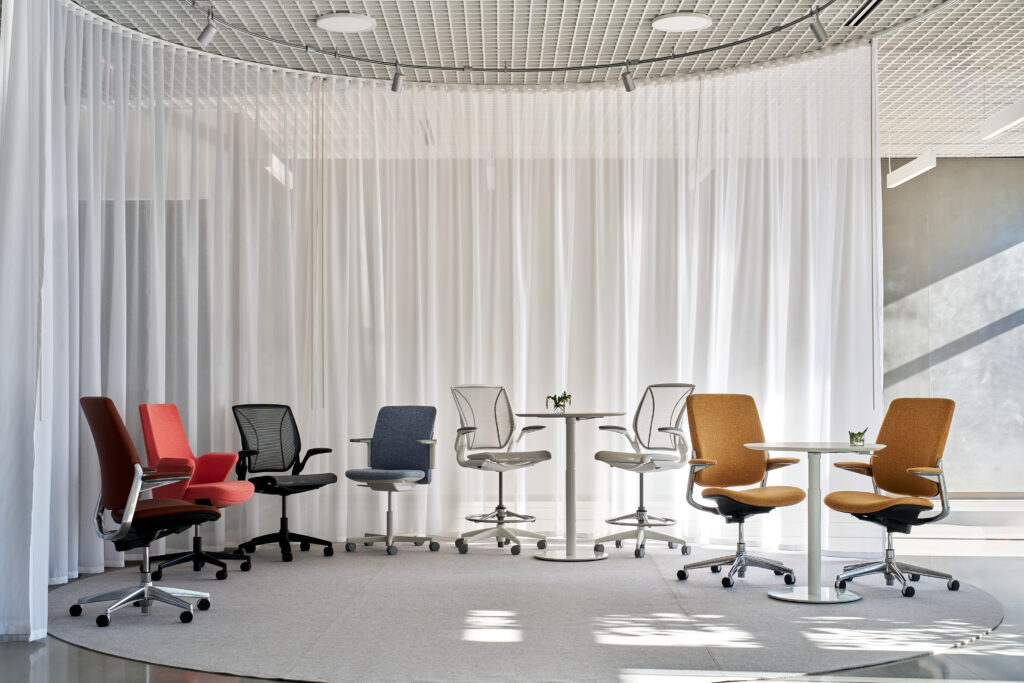
Photo Credit: HUMANSCALE
Budgeting for Certification
Early in Schematic Design, the team analyzed the Living Building Challenge Petal requirements and budgeted for additional hard and soft costs. Initial estimates were much higher and team was able to eliminate some strategies due to exceptions in the Petal Handbook that excluded “Interiors” projects. The preliminary budget considered additional costs related to but not limited to the following: additional consulting and design fees, certification fees, indoor air quality testing, FSC-certified wood, construction waste management, and donations.
One of the major coordination challenges for the project was FSC-certified millwork. The team had to contact several local millwork shops to find an FSC-certified shop that could meet the rigorous construction schedule. One contractor considered becoming FSC-certified to support the project, but ultimately decided not to pursue the certification. The team was able to find a local shop to meet FSC and schedule goals.
Another major cost consideration was FSC-certified wood flooring. The initial design proposed a white oak solid hardwood floor. Team had difficulty finding a solution that was Red List Free, FSC-certified, had short lead time to meet rigorous schedule, and met low VOC emission CDPH testing. Generally, FSC-certification added hard cost and lead time. Many residential-grade products did not have CDPH testing. In the end, team chose to forgo the hardwood floor solution and move forward with a poured-in-place concrete flooring, which compliments the furniture displays and makes the Humanscale products shine. Team agreed the poured flooring was the best fit in the end but team spent a considerable amount of time researching various hardwood floor options that were ultimately not installed.
Lastly, the team initially specified Red List Free lighting fixtures with a long lead time that could not meet the rigorous schedule. The team chose to proceed with Red List Free lighting fixtures from Finelite with similar performance but slightly greater energy consumption. As a lesson learned for other projects, the longer lead time for some Red List free and/or FSC-certified materials created a challenge for this small scale fit-out project with a constrained construction schedule.

Photo Credit: humanscale
Product Selection / Material Reuse
Local manufacture requirements had major impact on product selections. Team chose to proceed with Rockfon ceilings because they were manufactured locally in Chicago, Illinois. Other similar products were manufactured overseas. The team investigated wood flooring options and one sustainable option complied with Red List and CDPH was manufactured overseas. Since wood flooring was a major percentage of the cost of the project, it skewed the local manufacture calculations. The Team created a live calculator to test substitutions and material selections in real time and understand how selections impacted various Imperatives.
The fit-out space was a cold dark shell with a dirt floor upon signing the lease, so there were limited reuse opportunities prior to start of work. The team specified a new concrete floor with 40% alternative cementitious material to replace Portland Cement, thereby reducing embodied carbon in primary structural materials.
Humanscale had an existing sales office in the suburbs of Chicago. The team evaluated the existing space for reuse opportunities but the fit-out was more than 10 years old and many products were at the end of their useful life. During design, intent was to keep the existing sales office in operation concurrently with the new Chicago showroom so reuse opportunities were limited to minimize disruptions to team working in the space.
Team identified wood doors would be a challenge to meet FSC, Red List and low VOC emission CDPH compliance and so design documents required salvaged wood doors. Many wood doors are manufactured with formaldehyde-based resins. The Contractor was able to source 8’ high salvaged wood doors from a nearby project. The Contractor appreciated that the salvaged doors had no lead time and supported rigorous schedule goals. Fire-rated wood doors had to be purchased new to meet code requirements.
Another reuse opportunity was reused furniture. Humanscale had installed furniture at a pop-up event space for Chicago-based conference Fulton Market Design Days and stored the furniture for future installation in the space.

Photo Credit: HUMANSCALE

Photo Credit: HUMANSCALE