
Project Overview
| Project Name | MIT Building 55 |
| Certification Type | Zero Carbon 1.0 |
| Location | Cambridge, MA |
| Typology | New Building |
| Start of Occupancy | 12/01/2022 |
| Occupancy Type | Educational |
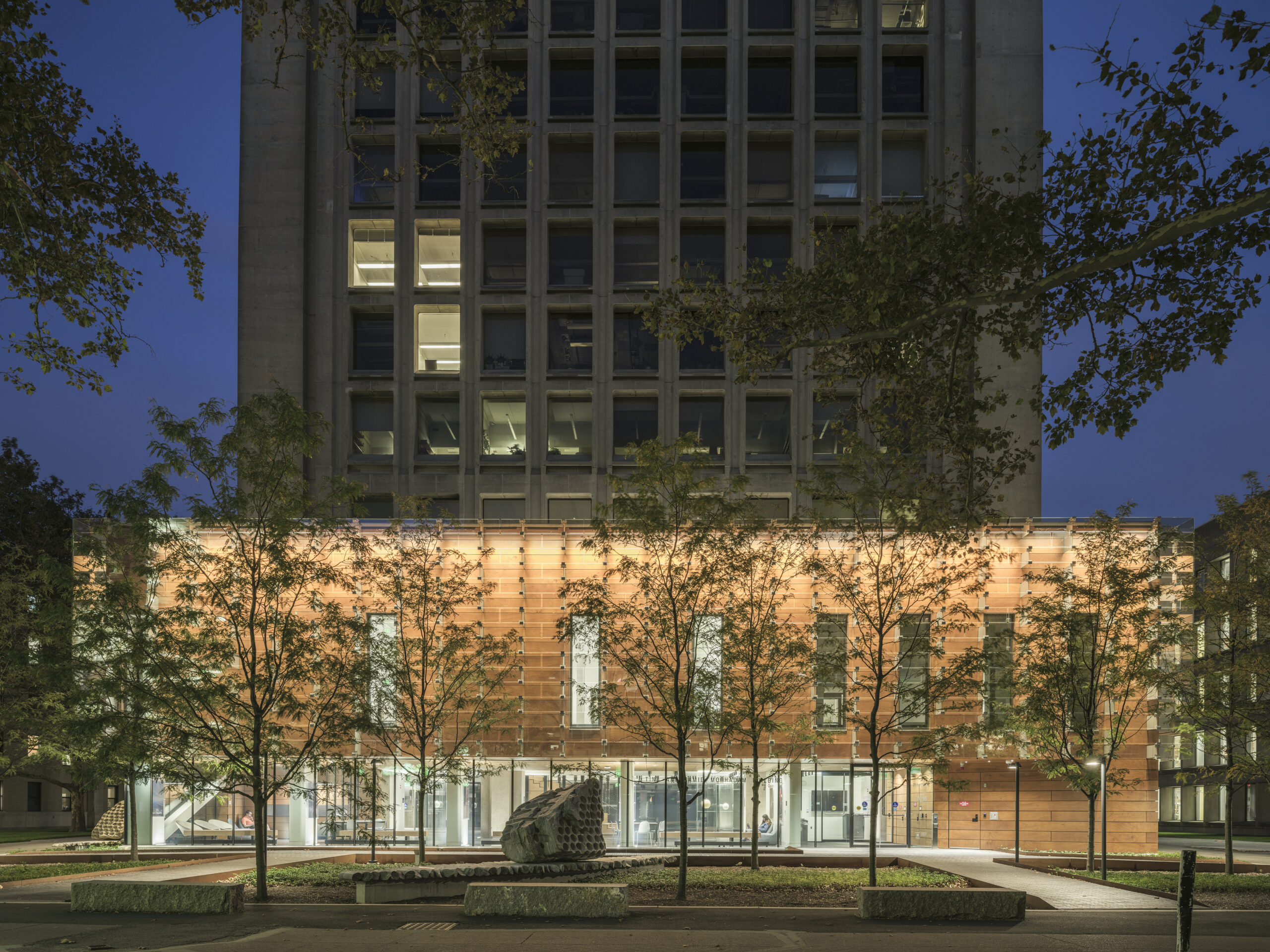
Photo Credit: © AW-ARCH / Photo: Florian Holzherr
The Tina and Hamid Moghadam Building (Building 55) is a complementary addition to the iconic Cecil and Ida Green Building (Building 54), together forming a new gateway and headquarters for MIT’s Department of Earth, Atmospheric and Planetary Sciences. The Green Building’s formal symmetry and contained simplicity establish a clear architectural order, which the project respects and builds alongside through careful siting, scale, and material restraint.
Building 55 serves as an interdisciplinary hub for earth, environmental, and climate sciences, strengthening connections across departments and to the broader MIT community. Set within a grove of trees north of the Green Building, its wood- and glass-veiled volume extends the surrounding landscape and shapes a sequence of arrival that is both civic and ecological. Together, the addition and renovation reinforce MIT’s commitment to resilience, environmental responsibility, and shared academic space.
Project Team
| Owner | MIT |
| General Contractor | Barr & Barr |
| Architects | AW-ARCH |
| Landscape Architect | Reed Hilderbrand |
| MEP Engineer | Arup |
| Civil Engineer | Nitsch |
| Structural Engineer | Arup |
| Certification Consultant | Arup |
Early Design Process
The Tina and Hamid Moghadam Building (Building 55), initiated in 2019, houses a department focused on climate, MIT’s Department of Earth, Atmospheric and Planetary Sciences (EAPS). A key driver for the project was to evaluate innovative strategies to address sustainability and, specifically, the potential to explore the environmental impact of building materials.
As part of the initial sustainability charrette, the design team discussed the potential of addressing embodied carbon and specifically implementing the ILFI Zero Carbon Certification. Since the certification was approximately one year old, concerns arose regarding the learning required and the state of the building materials industry at the time. After discussions between MIT, the design team and the construction manager, the team decided to integrate the certification as part of the design process, while monitoring the ability of industry to meet the needs of the project. Whole building life cycle assessments were integrated into the design process starting in design development to ensure that the team was able to meet targets.
One of the key considerations was the availability of lower embodied carbon building materials and the state of environmental product declarations. Mass timber was evaluated early on for the structure. However, because the existing building is Type I construction with concrete as the primary structural material, the team was required to use concrete to meet the intent of the design. As a result, the design team worked to explore options for lowering the embodied carbon of concrete. The team explored options for using less cement through the incorporation of supplementary materials, such as fly ash and slag. The design team identified, in collaboration with the construction manager and a local concrete supplier, a proprietary concrete mix design with a 60% reduction of embodied carbon that was used in foundations. As a result, the team was able to reduce the total embodied carbon of concrete in the building by approximately 22% while optimizing for performance, schedule limitations, and design requirements. This was a key component in enabling the team to meet its goals and to pursue certification.

Photo Credit: © AW-ARCH / Photo: Florian Holzherr
Occupancy
MIT has a campus Central Utilities Plant that serves the majority of its campus buildings. The Tina and Hamid Moghadam Building (Building 55) is one of those buildings connected to the Central Utilities Plant. The building has no on-site combustion and uses water source variable refrigerant flow (VRF) systems as a source for both heating and cooling. The VRFs are set up to extract heat from or reject heat to the campus chilled water systems with the goal of enabling a more efficient operation of the Central Utilities Plant. More importantly, for the current operation of the building, this setup allows the chilled water to be positive (i.e., the building is “consuming” chilled water) when the building is predominantly cooling, or negative when the building is predominantly heating (i.e., the building is extracting heat from the chilled water systems, returning colder water to the loop). This strategy delivered during the performance period and resulted in significant energy savings in the winter months, reducing the overall EUI of the building from 45.4 to 34.6 kBtu/ft2/yr.
While the VRF units provided energy savings, MIT also encountered some challenges with the quality of the water being used for the VRFs. The condenser water is sourced from the MIT campus chilled water loop, with the water being directly fed from the return side of the loop. Separation of the condenser water loop from the campus chilled water loop would have allowed tighter control of the water quality and could potentially have prevented some of the faults the system experienced during start up. The team is in the process of adding filtration for the chilled water to maintain water quality and prevent strainer clogging.

Photo Credit: Gretchen Ertl
Lessons Learned
The Tina and Hamid Moghadam Building (Building 55) is composed of both an addition and the renovation of the first two floors of the Green Building (Building 54), an 18-story tower by I.M. Pei built in the 1960s. The program of the existing building consisted of two separate entry lobbies separated by an outdoor open thoroughfare on the first floor and an auditorium on the second floor. The team was adding approximately 11,900 sf of new space that would infill the space between the existing lobbies to create a new lobby with exhibition spaces and convening spaces, new classrooms, and offices while renovating the lecture hall in Building 54 for a total project of approximately 20,000 sf.
Because the project was neither a new building nor a full renovation of an existing building, this added complexity to establishing baselines, goal setting, and energy and life cycle analysis modeling for the project. From an energy performance perspective, a key question was how to establish energy targets for the renovated lecture hall and the addition. Because the Green Building does not have submetering, the team collected building-level energy data and information on building envelope and MEP equipment and systems. The team then modeled the existing spaces and calibrated them against the building level information. With this information, the team was able to establish an operational goal aimed at offsetting all the added energy footprint of the new addition through the renovation of the existing lecture hall.
Similarly, conducting a whole building life cycle analysis for this project required a new approach to addressing the baseline. As the structure on the first two floors reflected the high-rise nature of the existing building, the team realized that they could not create a baseline based on the existing structure. The team established a new baseline and worked with ILFI to get approval for the approach. The new baseline enabled the team to take advantage of while not over estimating the impact of the existing structure on the embodied carbon of the project.
Finally, the team spent a lot of time identifying how to meter the project to meet the needs of ILFI, MIT, and the City of Cambridge. Three levels of metering were required:
- Maintaining the building level metering for Building 54 as a whole, which includes the renovated lecture hall
- Metering for the Building 55 addition only, not including the lecture hall
- Metering that encompassed the Building 55 project: the addition and the lecture hall in Building 54
Furthermore, because the buildings are connected to the Central Utilities Plant (CUP), separate meters were needed to address the services provided to the building from the CUP. The two buildings receive water and electrical service from the same source and chilled water from different loops. This added complexity to the metering setup and required significant coordination during design, construction, and turnover with MIT operations engineers.