
Project Overview
| Project Name | Neumann Monson Iowa City Studio |
| Certification Type | Core Green Building Certification |
| Location | Iowa City, Iowa |
| Typology | Existing Building |
| Start of Occupancy | 10/05/2023 |
| Owner Occupied | Neumann Monson Architects |
| Occupancy Type | Commercial |
Neumann Monson Architects
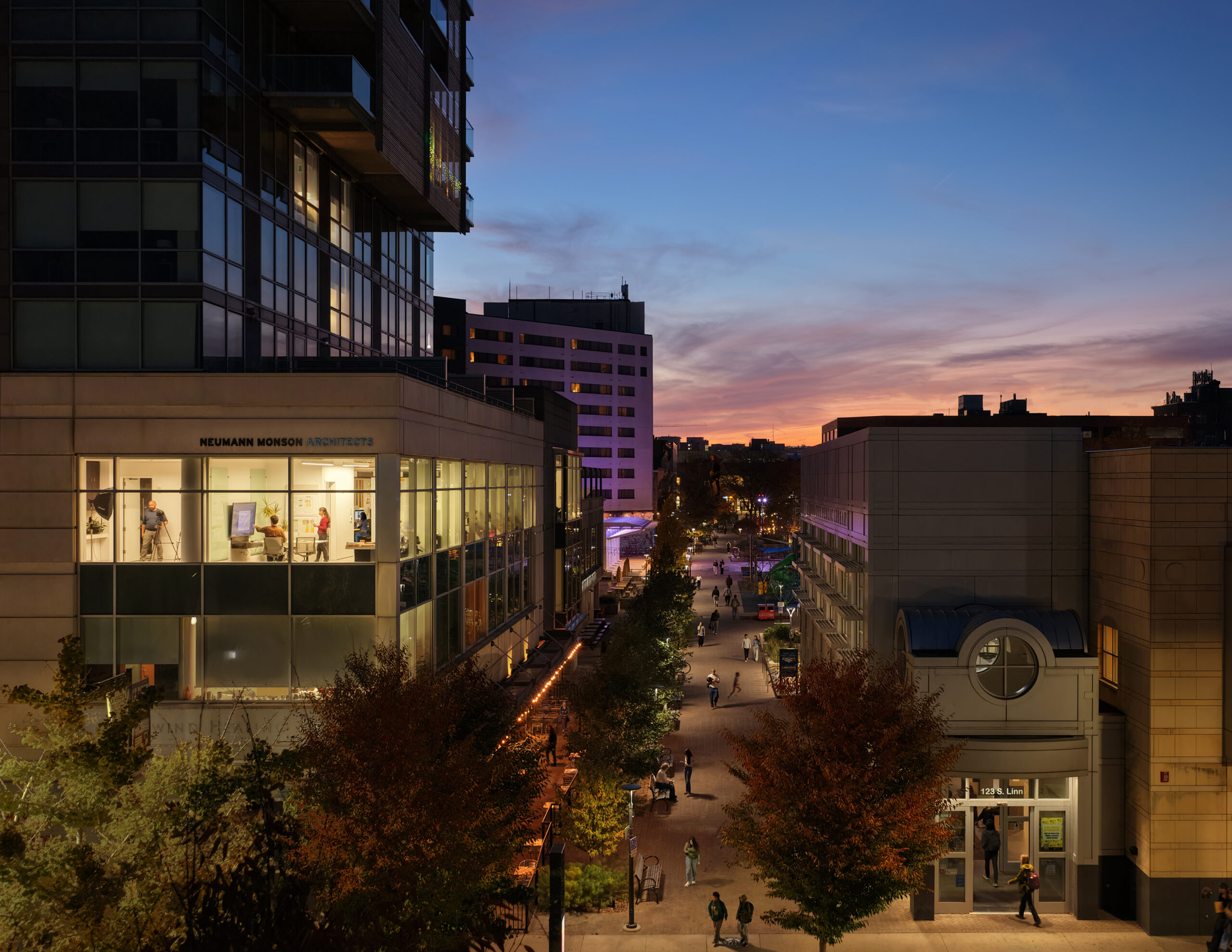
Located in a 15-story mixed-use building within the downtown district of Iowa City is Neumann Monson Architects Iowa City design studio.
Project Team
| Owner | Neumann Monson Architects |
| Building Representative | N/A |
| General Contractor | McComas Lacina Construction |
| Architects | Neumann Monson Architects |
| Landscape Architect | N/A |
| Mechanical Engineer | Design Engineers |
| Civil Engineer | N/A |
| Furniture Consultant | Workspace |
| Interior Design | Neumann Monson Architects |
| Sustainability Consultant | Integrated Eco Strategy, LLC |
C2- Human-Scaled Living
Neumann Monson Architects’ Iowa City Studio maintains the site density and thoroughly encourages a human-powered lifestyle.
The project increased its daily employee capacity from 34 to 40, with phasing plans for 50. The new projectembraces various ways of working, with dozens of workpoints throughout the studio for various postures, views,and privacy levels. The project serves as an examples of a large scale workplace in Iowa City’s urban center.
Previously with no space for hosting community events, the nearly 1000 square foot forum near the project’s entryis a flexible space ideal for hosting events – internal or external. Mobile tables and mobile display boards are set inan open area surrounded by a gallery entry area, a large kitchen facing the forum, and a series of threeconference rooms.
Considering the project’s location on the third level of a 14 story mixed use building, a complementary approachwas utilized for bike storage. Four vertical bike storage racks and open gear cubbies are near the project’s backdoor. For those who prefer to not navigate up to the studio with their bike, the public library offers ample camera-secured, weather protected bike storage about 200 feet from the building’s main entry. The complementaryapproach allows bike commuters to use the storage method best suited for them.
Prior to the project, about 40% of the project occupants commuted to work sustainably – on foot, bike, or in anelectric vehicle. This made a 30% reduction especially difficult, so the project team opted for four best practices.These practices enhanced our existing approach to sustainable transportation. Conversations about enhancedbicycle infrastructure, company policies, and structuring carpools were all continued as a part of this imperative.
C5 – Healthy Interior Environment
At the core of our effort to create a healthy interior environment is our healthy indoor environment plan (HEIP). Thisplan guides our commitment to maintaining healthy cleaning protocols, improving our air quality, and minimizingparticulate matter such as dust. Part of this effort was incorporating low volatile organic compounds (VOCs) –materials that emit fewer harmful chemicals – promoting a healthier environment not only for our team, but alsoduring the construction process. Additionally, as part of our ongoing effort of our indoor environment plan, the HVAC and plumbing systems are monitored and changed quarterly by a third-party company to ensure continued performance and efficiency.
The HVAC system in our studio was implemented because of its commitment to efficiency and indoor air quality. It features high efficiency filters designed to effectively capture harmful particles, promoting a healthier indoor environment. Central to this system is the rooftop Energy Recovery Unit (ERU) that facilitates air exchange and climate control. These controls ensure that indoor temperatures are better aligned with outdoor temperatures, enhancing comfort while maintaining energy performance.
Importantly, the ERU protects the air coming into the building from mixing with the air leaving the building.In alignment with the ASHRAE 62.1 standard – a recognized standard for ventilation and acceptable indoor air quality – the project design included a direct exhaust for the laser cutter in our studio. The laser cutter is typically used for cutting model-making materials like chipboard or acrylic, oftentimes releasing fumes. To address this, weincorporated a vacuum that operates as the laser cutter does. The vacuum carries the fumes directly to theexhaust ductwork and to the ERU for safe exhaust.
In addition to these mechanical strategies, we chose to incorporate biophilic strategies to improve our air quality. For example, fragrant plants are strategically placed throughout the studio, not only contributing to ouratmosphere, but also creating a pleasant atmosphere that reinforces our approach to occupant well-being.

COPYRIGHT: Cameron Campbell, Integrated Studio
C6 – Responsible Materials
The goal to utilize honest and healthy materials was one of the largest priorities of our studio renovation. This prioritization of natural materials in lieu of laminates and composites allowed for local sourcing, reduced VOC’s, and even led to carbon sequestration from solid ash wood. Ultimately, we knew that we wanted to reduce our carbon footprint as much as possible. Therefore, it was critical to reuse as much of our previously existing materials as wecould. Throughout the project, approximately 80% of the construction waste from our studio was reused, recycled, or donated. A few key materials that were reused include the ceiling tiles and doors (100% reused), glass (99% reused), and casework (76% reused). When reusing new materials wasn’t feasible, we chose to seek out materials that are part of the AIA’s Materials Pledge. For instance, our carpet, ceiling grids, conduits, wall paint, and felt upholstery all have Declare Labels.
To embed our values in the studio’s design, we chose to focus our efforts on incorporating local materials into the project – allowing us to support the local economy, reflect the community we call home, and ultimately reduce ourcarbon footprint. In total, 40% of our materials were sourced from within a 300-mile radius. The ash wood highlighted throughout the studio was sourced from Iowa City, Coralville, and Tiffin – each 15 miles or less from the project site. The hardwood was found in local parks where trees were either dead, dying, storm-damaged, or infected by the Emerald Ash Borer – an invasive insect. It was then processed by Koffron Hardwoods in Tiffin and assembled by craftspeople at McComas-Lacina Construction in Iowa City prior to arriving onsite. You can now findthis ash hardwood as a prominent feature at the workstations, tabletops, and hospitality bar in our studio.

COPYRIGHT: Cameron Campbell, Integrated Studio
C8 – Universal Access
Equitable use was a guiding principle for the design team. This project extensively used salvaged casework from the previous fit out, and all re-used lower casework was cut down to have a 34” work surface. New casework and tables followed the same approach, with no surfaces above 34”. Workstations are spread throughout the same studio space, with no hierarchy of sizing, location, or private offices. These workstations are electronically height adjustable, ranging from 24”-50”, accommodating nearly all users and postures, adjustable with a simple button.These workstations can be supplemented by pedestals and/or credenzas, customizable by each user to match their storage and functional preferences.
Clear, succinct information was also a priority. High contrast clear labels are frequently used, like labeling kitchen waste types, workroom storage, and model room storage. Nine instances of educational signage are spread throughout the studio, and each is high contrast with a minimum of size 15 font.
To create a tolerance for error, all kitchen drawers and cabinets are soft close. Additionally, brittle column wrap textures are protected by metal column enclosures. The space is adaptable and dynamic with little user effort. Many studio items are on wheels, like all new tables, most chairs, and all project home dividers.
To provide space for approach and use, high traffic areas are allowed ample floor space. This ensures that the front entry, forum, and back entry remain functional for all users. ADA requirements were used as a minimum as the design team made decisions.
Overall, the project showcases how universal design can be achieved in a renovation, utilizing salvaged materials and in-situ elements.

COPYRIGHT: Cameron Campbell, Integrated Studio
C8 – Inclusion
From the outset of the NM IC Studio Renovation, we recognized that environmental performance alone wasn’t enough. To align with the Living Building Challenge CORE framework, we prioritized social equity, transparency, and accountability across our project team, while also leading with the idea that sustainability must support both people and the planet.
Our firm has consistently maintained active JUST Labels (2.0 and 3.0), publicly disclosing performance across diversity, equity, employee well-being, benefits, and stewardship indicators. To broaden accountability, we collected JUST 2.0 self-assessments from five additional project partners. This process increased transparency across disciplines and encouraged each organization to evaluate its policies related to inclusion, compensation, andcommunity stewardship. In doing so, we reinforced a shared commitment to equity across the project team.
To incorporate the holistic framework, we invested in both high-performance systems and the social framework required for the CORE Certification, including sustainability consulting and certification fees. Beyond the project footprint, we extended our impact through a $2,500 donation to Iowa Valley Habitat for Humanity, supporting affordable housing in our community.
Through JUST participation, team-wide self-assessments, equitable compensation practices, and community investment, the NM IC Studio Renovation demonstrates that sustainability is inseparable from social responsibility. Our values are embedded not only in our physical space, but in the culture and partnerships that helped shape it.