
Project Overview
| Project Name | Pā Reo |
| Certification Type | Living Certified |
| Location | Otaki, New Zealand |
| Typology | Building |

Photo Credit: ANDY SPAIN
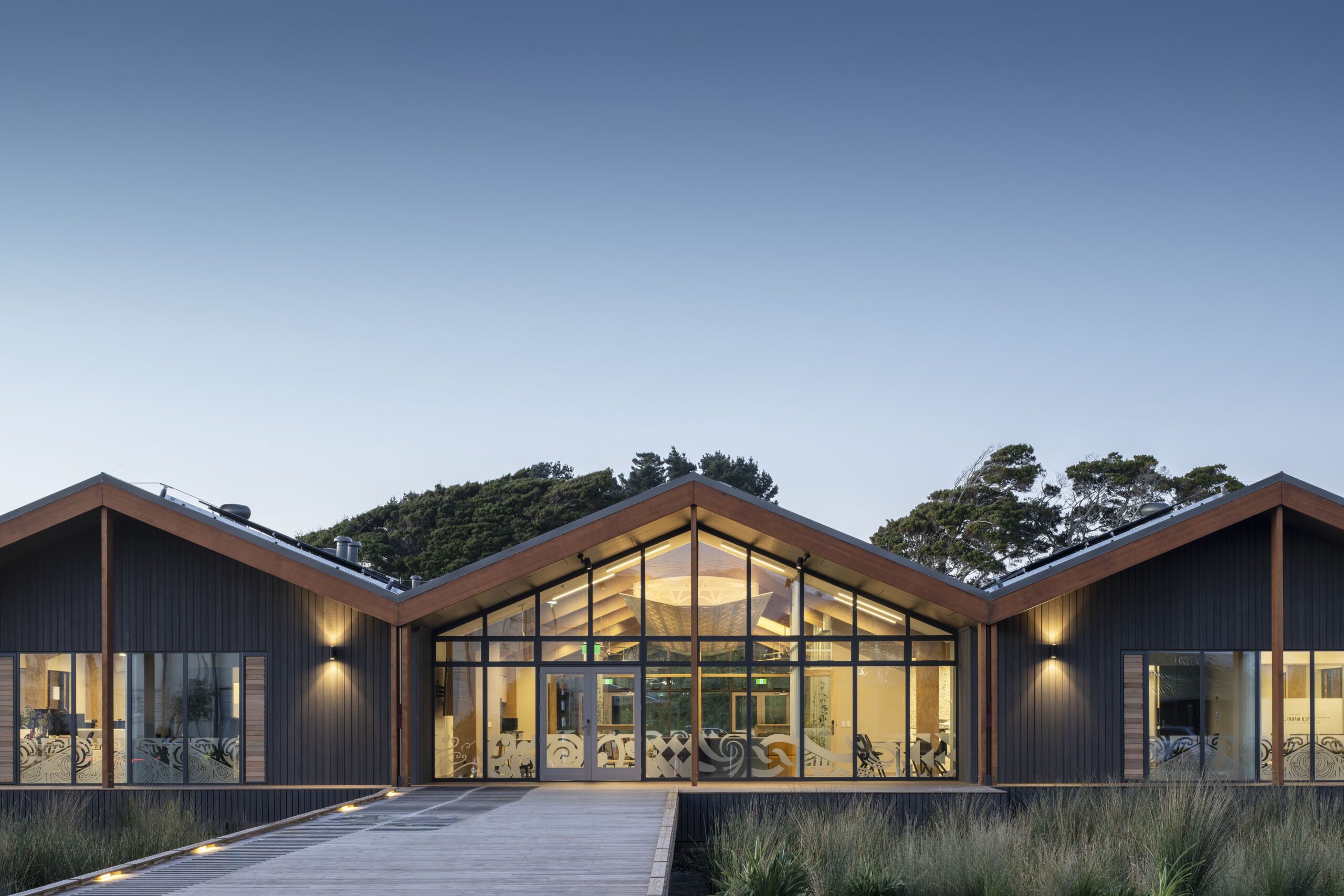
Pā Reo Campus, in Otaki, New Zealand, is envisioned to reflect and support ngā kaupapa (the protocols) o Te Wānanga o Raukawa. Creation of Pā Reo – an enclave of one administrative (Te Moana o Raukawa) and three research and educational facilities (Waitapu, Rangataua, Mīria te Kakara), within a broader campus master plan, to support te reo Māori ānake (only). This project is the fourth project to be constructed by Tennent Brown at the Wānanga, and represents a strong ongoing relationship. The design exercises efficient use of built spaces and economy of design, manifesting in low ongoing maintenance costs and flexible spaces.
Project Team
| Owner | Te Wananga O Raukawa |
| General Contractor | McMillan Lockwood |
| Architect & Interior Design | Tennent Brown Architects |
| Landscape Architect | Wraight and Associates |
| MEP Engineer | 335 Ltd |
| Civil Engineer | Landmatters |
| Acoustic Engineer | Marshall Day |
| Structural Engineer | Dunning Thornton Consultants |
| Sustainability Consultant | Ewan Brown |
| Principal Planner | Leith Consulting |
| Quantity Surveyor | Rider Levett Bucknall |
| Water Engineer | Morphum Environmental |
| Fire Engineer | Holmes Fire |
| Traffic Engineer | Wanty Transport Consultancy |
| Geotechnical Engineer | ENGEO |
Early Design Process
The Pā Reo project was initiated by Te Wānanga o Raukawa as part of a long‑term vision to normalise and strengthen te reo Māori within everyday teaching, learning, and administration. From the outset, the project was kaupapa‑led rather than architect‑led, with cultural values, rangatiratanga, and kaitiakitanga forming the foundation for all subsequent decisions.
The core design team was assembled early, with Tennent Brown Architects engaged alongside key consultants who had experience working within kaupapa Māori contexts. The client’s leadership group remained closely involved throughout the process, ensuring continuity of intent from briefing through to occupation. The Living Building Challenge (LBC) was first discussed during early design conversations as a potential framework that could align environmental regeneration with the Wānanga’s cultural and social aspirations.
The possibility of LBC certification was initially raised by the architect, who was already a Living Future Ambassador and had experience with the framework. However, the decision to pursue certification was ultimately client‑led. The client recognised that LBC offered a values‑based structure that resonated strongly with Māori worldviews — particularly the emphasis on long‑term stewardship, intergenerational responsibility, and net positive outcomes rather than harm minimisation.
Once the decision was made, it was clearly communicated to all project participants. Importantly, this was not treated as a technical overlay but as a shared kaupapa. The architect led multiple induction sessions with consultants, contractors, and subcontractors to explain the intent of the Living Building Challenge, the implications for material selection and construction practice, and the cultural significance of the project. These sessions emphasised collective responsibility, reinforcing that everyone on site had a role to play in achieving certification.
Early misconceptions — particularly the perception that LBC was primarily about cost or compliance burden — were addressed through education and transparency. By framing LBC as an extension of the project’s cultural values rather than a separate sustainability agenda, the team was able to build genuine buy‑in. This early alignment proved critical during later stages, particularly when navigating material compliance, construction challenges, and audit requirements.
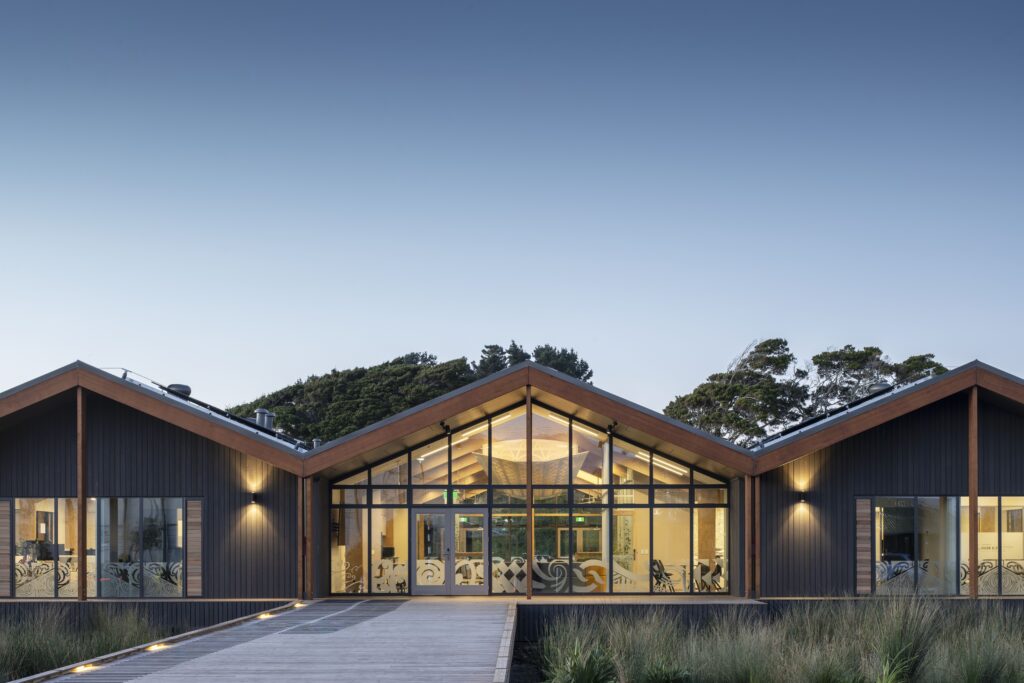
Photo Credit: ANDY SPAIN
Product Selection + Material Reuse
Material selection for Pā Reo was driven by a combination of cultural appropriateness, environmental performance, and Living Building Challenge requirements. Timber was selected as the primary structural and architectural material due to its alignment with Māori concepts of whakapapa, renewability, and repair, as well as its significantly lower embodied carbon compared to steel and concrete alternatives.
The project team undertook early comparative analysis of structural systems, assessing embodied carbon, durability, construction efficiency, and long‑term maintenance. Timber consistently emerged as the preferred option, both technically and culturally. All structurally engineered wood products and LVL were grown and manufactured within approximately 380 kilometres of the site, strengthening the local materials economy and reducing transport emissions.
A particularly significant aspect of the project was the depth of materials documentation undertaken to meet the Materials Petal. The team tracked and documented 2,559 individual materials, identifying their city of manufacture and distance from site. This enabled full compliance with Living Economy Sourcing requirements under the Oceania exception, with clear evidence of regional, national, and broader sourcing thresholds being met.
Several materials were new to the team, including thermally modified radiata pine cladding sourced locally. This material was used to achieve durability and weather resistance without reliance on chemical treatments, aligning with Red List requirements. The team also engaged directly with manufacturers and suppliers to obtain Declare labels, FSC documentation, and ingredient disclosures where these were not initially available.
Advocacy played a key role in this process. In several instances, manufacturers were required to provide additional transparency or modify documentation to meet LBC requirements. While time‑consuming, this engagement strengthened supplier understanding of regenerative design expectations and contributed to broader industry learning.
The material strategy for Pā Reo demonstrates that rigorous material compliance is achievable on complex projects when embedded early and supported by strong values alignment. The project provides a replicable model for teams working in regions with limited Declare availability, showing how detailed tracking, early advocacy, and local sourcing can collectively meet Living Building Challenge aspirations.

Photo Credit: ANDY SPAIN
Community Engagement
Community engagement for Pā Reo was grounded in tikanga Māori and led by Te Wānanga o Raukawa as mana whenua and project client. Rather than a conventional consultation process, engagement was ongoing, relational, and embedded within the governance and design of the project from inception.
The project sits within an existing campus that serves students, staff, whānau, and the wider community. Engagement therefore occurred across multiple layers — from governance and leadership discussions to day‑to‑day interactions with staff and learners. The design team worked closely with the client to ensure that architectural decisions supported cultural practices, spatial customs, and the lived experience of te reo Māori being spoken, taught, and normalised.
Key aspects of engagement included collaborative design workshops, regular hui, and shared decision‑making around site planning, building form, and landscape design. The concept of a contemporary pā reo emerged directly from these discussions, shaping the clustering of buildings, the pedestrianisation of the site centre, and the creation of shared outdoor spaces for gathering and learning.
The landscape strategy further reinforced community connection, incorporating ethnobotanical planting, rongoā species, and māra kai. These elements support both cultural practice and wellbeing, while also contributing to ecological regeneration. Plantings were selected in collaboration with local knowledge holders and are used actively by the Wānanga and associated kōhanga reo.
Challenges did arise, these were addressed through open dialogue and a shared commitment to kaupapa over expediency. Rather than defaulting to standard solutions, the team consistently returned to first principles, ensuring that regulatory and certification requirements did not undermine cultural integrity.
The success of community engagement at Pā Reo lies in its authenticity. The project did not seek to “include” the community; it was created by and for the community it serves. This approach offers a powerful model for future projects, demonstrating how regenerative design can be strengthened when community leadership, cultural knowledge, and environmental responsibility are genuinely integrated.

Photo Credit: ANDY SPAIN
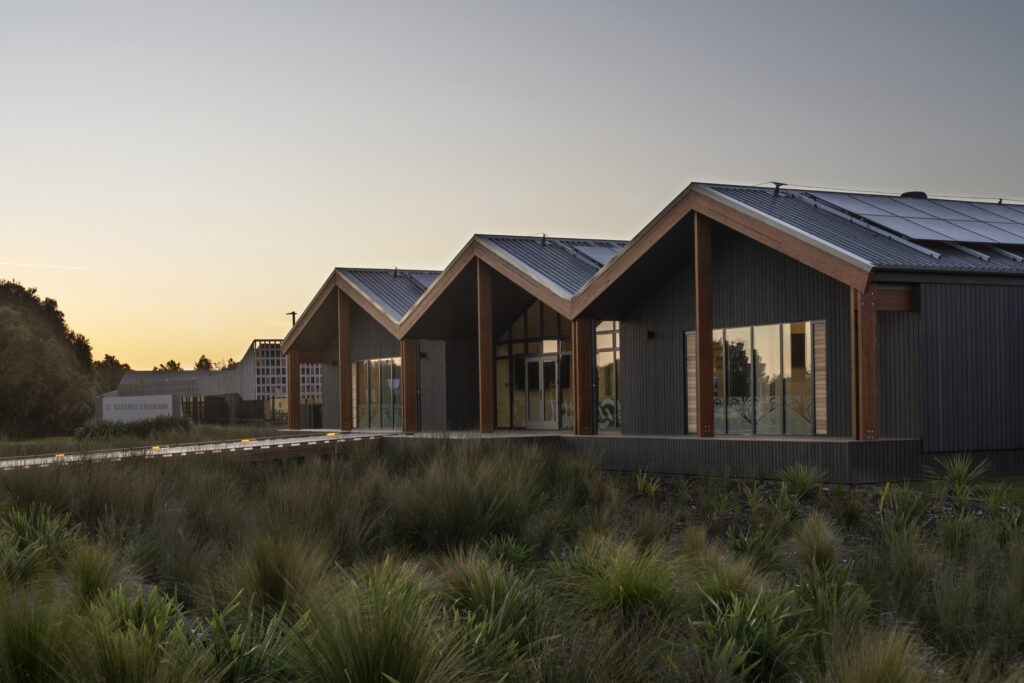
Photo Credit: ANDY SPAIN