


I01: Limits to Growth
The history of the project site always has and always will begin with indigenous people. Central Oregon figures prominently in the transhumance lifestyle of several indigenous groups and most consistently considered home by the Warm Springs, Wasco, Klamath and Northern Paiute people. However, this region saw many peoples and tribes move through, many on their way to and from the Columbia Gorge.
The project site is located on a previously developed plot of land next to the Deschutes River in a quiet neighbourhood walking distance from Downtown Bend. The site was originally developed for a timber mill and played a part in the early Euro-Anglo settlement of the area. The River Sol project worked to honor the legacies of the site that came before it and give back to the land for the duration of its (hoped) 250 year lifespan.
I02: Urban Agriculture
Nestled along the Deschutes River in the upper portion of the watershed, River Sol has the unique challenge of producing food in a dry climate where a short growing season with frost, snow, or microbursts of hail in any of the summer months is not an uncommon occurrence. However, Central Oregon has abundant sunlight, and given the opportunity, many plants thrive in this climate. Due to the challenging nature of our region, we decided to use a diversified approach to River Sol’s agricultural production, implementing perennial polycultures, native fruit-bearing plants, and annual crop production.
The general agricultural approach used permaculture principles, incorporating a holistic framework for productive place-based systems. This approach offers many benefits, including diverse crops, maximizing use of space, stacking functions, and reducing long-term inputs into the system. Incorporating and using native plants in food production is also a key element in River Sol’s approach to agriculture. Native fruit-bearing trees (apple, pear, and peach) and shrubs have evolved to be well-adapted to this region and are suited to meet the challenges of the climate. Each plant species in the system was selected for its unique characteristics, including cold hardiness, length of the growing season (e.g., late blooming / early ripening varieties), water needs, soil type preferences, and overall mature size. These traits lend themselves to successfully producing a crop for harvest here in Central Oregon.

I03: Habitat Exchange
The River Sol Project was fortunate to have worked with a handful of accredited land trusts to find a project that both met the intent of the Habitat Exchange Imperative and the priorities of the project owners. In particular, connecting valuable habitats and increasing landscape permeability was a major focus when finding a land trust and project to work with.
Eventually, the River Sol team began working with the Mackenzie River Trust. The McKenzie River Trust is a nonprofit land trust formed in 1989 to protect critical habitats and scenic lands in the McKenzie Basin. Since 2000, their service area has included the Oregon watersheds of the Long Tom, Upper Willamette, Coast, and Middle Forks of the Willamette, Umpqua, Siuslaw, and coastal streams and lakes from Reedsport to Yachats. The River Sol Team supported the MRT’s an acquisition of high conservation value; A 287-acre property consisting tidal wetlands on the central coast of Oregon. Part of a larger protection envelope of land, acquiring this property filled a final protection gap and allow McKenzie River Trust to assess restoration opportunities throughout the watershed that will enhance or reestablish historic floodplains in the river basin.
I04: Human Powered Living
River Sol is located in Bend, Oregon, between downtown and the 3rd Street commercial zone, and it’s close enough to take advantage of the goods, services, and transit locations offered in both areas. River Sol is considered “very bikeable” with a score of 71. The Bend City Council has approved bond funding to establish and/or improve bike corridors between the city’s east and west ends, so we anticipate River Sol’s bike score to rise over time. While cycling will be the quickest mode of transportation to and from River Sol, the project site is also well situated for walking. It takes just 15 minutes on foot to walk downtown for goods, services and cultural events. And the journey downtown is pleasant, following a path along the Deschutes River and moving through a park. With a walk score of 57, errands and nights out are accessible and enjoyable on foot. There is public transit in the area and multiple bus lines are approximately a 15 minute walk away from the property. However, public transit is certainly the least accessible with limited transit options and limited service times which is why the project team advocated to the City to improve public transit operations for all residents.
I05: Net Positive Water
The Rainwater Harvesting System allows River Sol to operate independently from the municipal water supply system. The roof slope and orientation were designed to simplify water collection by directing the runoff to a single point, a downspout on the southeast side of the home. In addition, a snow guard was installed along the roof edges to retain snow and ensure snow melt is captured in the harvesting system. Gutter screens above the downspout and a vortex filter at cistern inlet ensure leaflitter, conifer needles, and other debris stay out of the system. The captured water is then sent to an underground, 600gallon Norwesco collection tank before being pumped into the cisterns. The cisterns are two salvaged shipping containers lined with locally produced pond liner to ensure water retention. Within the cisterns, a circulation pump was installed to avoid freezing during winter months and a sump pump was installed to supply water to the home. A level monitor within the containers allows the project owners to monitor their water levels. An overflow system was installed which discharges water directly into an onsite swale. The cisterns are outfitted with two access hatches to provide easy access into the interior of the cisterns.
From the cisterns, the water is then sent into the mechanical room along the south wall of the garage, directly beside the cisterns. Within the Mechanical room, water is treated by a sediment filter, two parallel charcoal filters, and finally a UV filter before entering the dwelling units for use.

I06: Net Positive Energy
Rive Sol’s strategy to achieve Net Positive Energy was multifaceted and planning began at early in the design phase. The first step was to minimize the energy load in the house. To this end, best-in-class appliances, high efficiency HVAC systems, and light fixtures were identified early on the the process. This allowed the solar engineers and architect to work collaboratively with the project owners on the project design with a good idea of the energy system that would be needed to support the project’s energy demands. The design features contributed significantly as well. Features like numerous Jeld Wen windows in almost every room and large glass doors that allow the project to rely significantly on daylight for lighting needs. Lifebreath ERV systems were installed to reduce the heating and cooling load. Design feartures and paired with occupant behavioral strategies promote effiecient heating and cooling of the building. Central Oregon is the high desert which means significant temperature swings are experienced between day and night making passive strategies extremely effective. Lastly, a major focus was placed on the building envelop to minimize any potential heat gain and loss.
River Sol was designed with approximately 1,600 contiguous square feet of standing seam metal roof facing South at 180 degrees azimuth with a 9.5 degree tilt that was well suited for a roof mounted PV array.The PV array consists of 61 REC 410 watt solar panels. The total PV system size is 25.01kW, and the solar with battery storage system consists of 61 solar modules, 61 Enphase micro inverters and a 20kWh Enphase Energy Storage System. The PV system uses an all metal racking system affixed to the standing seam roof panels via a product manufactured by Unirac.
I07: Civilized Environment
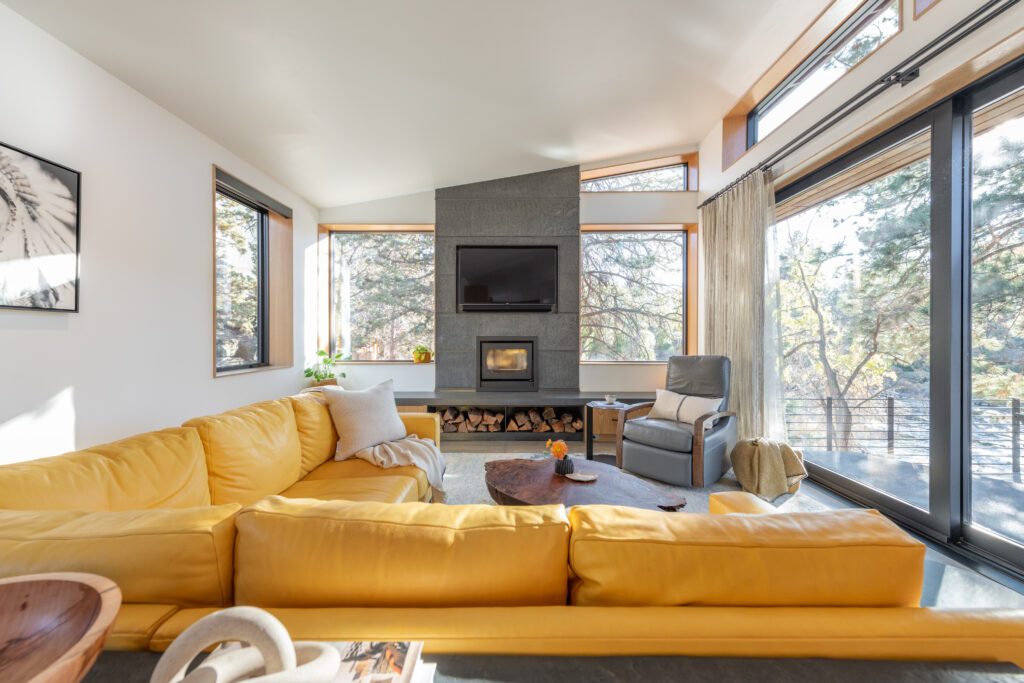
At the very core of the River Sol Project is the desire to create a comfortable, liveable, civilized environment for all occupants. Operable windows in every room, glass doors, and large sliding glass doors allow occupants exposure to daylight and fresh air no matter where they are in the building. However, a civilized environment is not just about letting the outside in on demand. Due to increasingly severe wildfires and smoke events across the West, these windows, doors, and the building envelope are critical tools to ensure that a civilized environment remains civilized even during wildfire season.
I08: Healthy Interior Environment
Maintaining a healthy interior environment is considerably easier to achieve for single-family residential projects compared to other project types. The owners and occupants of River Sol can maintain cleaning protocols, no smoking policies, walk-off processes at entry ways, and more. The River Sol home employs all of the above as well as passive solutions allowing for air exchanges over night through open windows, mechanical solutions such as use of the Lifebreath ERV, and up-front solutions via materials vetting and the use of only low or no VOC products and other healthy products.
I09: Biophilic Environment
The River Sol residence expresses biophilic design as a guiding framework for shaping both form and daily experience. Early in the project, the design team, led by consultants from Shepley Bulfinch, hosted a series of virtual biophilic design workshops during the COVID-19 pandemic to collaboratively articulate emotional, sensory, and ecological values that the home should embody. While challenging to accomplsh virtually, these workshops helped distill the project’s core experiential priorities into recognizable patterns of nature connection, such as direct views to the Deschutes River, sensory warmth, ritualized gathering spaces, and grounding through natural materials. The resulting spatial program uses themes like Nourish, Meditation, Connection, and Fire to guide how rooms relate to each other and to the surrounding landscape, ensuring the home supports well-being as much as high performance.
These values are directly mapped into the building’s architecture and site plan. The main level floor plan, for example, places indoor gathering and cooking spaces along view corridors to the river and gardens, while quiet zones such as the meditation room provide intentional retreat and reflection, reinforcing biophilic patterns of refuge and prospect. Outdoor rooms, edible gardens, and the careful siting of patios and breezeways emphasize seasonal rhythms and daily movements linked to sun, wind, and vegetation. The upper floor continues the design language with elevated “treehouse-like” spaces that evoke both canopy immersion and light-driven cycles. This spatial strategy embeds nature as both a life-supporting system and a meaningful presence illustrating how biophilic design can move beyond aesthetic gesture to become a shared language of care, community, and place.

I10: Red List
Meeting the Living Building Challenge Red List Imperative at River Sol required a rigorous and collaborative approach to material selection and documentation. The project team, led by Tozer Design, began by educating subcontractors about the intent behind eliminating toxic and high-impact materials, emphasizing not just the what but the why of healthier material choices. Drawing on prior experience with the Desert Rain Living Building project, the team utilized the Red2Green tracking platform and prioritized using fewer materials overall, reusing components wherever possible, and selecting products already vetted on other LBC projects. The team also reviewed Declare listings and consulted with peers such as Arch Nexus to streamline research and reduce duplication of effort. This early and structured approach enabled the integration of essential systems such as plumbing, lighting, and appliances, ensuring performance modeling was based on actual, fully vetted selections rather than assumptions.
However, the materials vetting process unfolded during the height of the COVID-19 pandemic, introducing significant supply chain disruption, documentation delays, and uncertainty from manufacturers who could not guarantee material consistency. The sudden passing of the project’s general contractor compounded these challenges, requiring additional time and coordination to verify invoices and product documentation. Cost also emerged as a persistent barrier, demonstrating the difficulty of achieving full LBC compliance at or near conventional residential price points which was an original goal of the project owners. Yet, despite these hurdles, River Sol achieved notable successes: salvage and reuse were prioritized, including the integration of a Phoenix composting toilet from the Bullitt Center and two shipping containers repurposed as cisterns; Declare-listed products were incorporated at a scale that far exceeded minimum requirements; and two formal exceptions were secured—one to support the clients’ desire for a fireplace, and another to use wildfire-salvaged cedar sourced through collaboration with a small mill and the U.S. Forest Service both of which connect this project closely to the ecological and historic legacy of fire on this landscape.
Ultimately, this Red List journey reflects both the difficulty and the transformative potential of materials transparency. River Sol contributes to a growing cultural and industry shift, one where healthier, lower-impact products are becoming more available, manufacturers increasingly understand the importance of ingredient disclosure, and project teams have better tools and peer networks to support this work. Indeed, the team routinely encountered comanies familiar with LBC and were prepared to honor our requests due in part to the work previous projects have done and the resources now available online. The successes of River Sol demonstrate that while the Red List Imperative remains challenging, it is also a powerful lever for improving building industry practices.
I11: Embodied Carbon Footprint
To understand and reduce the building’s embodied carbon impacts, the River Sol project team used the Athena Impact Estimator to model major building assemblies including the foundation, walls, roof, and framing systems. The tool allowed the team to quantify emissions associated with material extraction, manufacturing, transportation, and installation, providing a baseline from which to make intentional design choices. While Athena focuses primarily on assemblies with robust industry-average data, the team supplemented its use with detailed material tracking to ensure transparency and alignment with project goals. Carbon impact was an active design consideration, guiding choices that favored lower-impact, renewable, and regionally sourced materials.
A key success of River Sol’s carbon strategy was the prioritization of materials that inherently reduce emissions and the incorporation of salvaged and repurposed elements to avoid the carbon cost of new manufacturing. The design team selected wood framing instead of steel and worked closely with the concrete supplier to develop a custom low-carbon mix with reduced Portland cement content. This mix later received a regional sustainable concrete award. Additional reductions were achieved by sourcing windows and doors from a nearby manufacturer to minimize transportation impacts and repurposing steel shipping containers as durable on-site water cisterns. Together, these efforts reflect a proactive approach to carbon reduction grounded in collaboration, transparency, and a regional sense of material stewardship. The result is a project that demonstrates how embodied carbon can be meaningfully reduced through early intention, supplier partnership, and thoughtful material choices.
I12: Responsible Sourcing
All wood products were FSC certified and sourced from mills in Oregon and Northern California. Stone was sourced from Deschutes and Klamath counties in Oregon. The project included 28 Declare products and 5 salvaged products in its final construction and finish.

I13: Living Economy Sourcing
River Sol made a concerted effort to source products from within 500km of the project site. In particular, to reduce the project’s carbon footprint heavy products (like concrete) and products that were required in mass quantities (like wood, windows, and doors) were sourced from as close to the project site as possible. Ultimately, 56% of the project’s material budget was sourced within 500km, an achievement that the project team is extremely proud of and one that could not have been achieved without significant help from many partners and contributors.
I14: Net Positive Waste
The River Sol project approached waste reduction as a full life-cycle responsibility, beginning with design and extending through construction, operation, and eventual deconstruction. During design, the team selected materials for durability and long service life, prioritizing assemblies that would minimize replacement cycles and landfill impact over the building’s ~175-year intended lifespan. For example, metal roofing was chosen instead of membrane products to avoid multiple future tear-offs, and fiber-cement siding replaced wood siding to reduce material turnover. The project team further evaluated materials not only for performance but for their recyclability and salvage potential at the building’s end of life.
During construction, the project implemented a disciplined waste sorting system on-site, with designated zones for metals, cardboard, soil and biomass, insulation, rigid foam, and general waste. Education and accountability were key: subcontractors attended waste management trainings before work began, signage was created using repurposed materials, and each crew was required to complete a daily waste checklist. Under the leadership of the general contractor, River Sol exceeded the required diversion rate for all catagories by researching and coordinating with local recyclers and thoughtful reuse strategies, such as reclaiming fiber-cement panels and repurposing wood. The key to River Sol’s success was through embedding stewardship and waste management into every phase, from what is specified, to how it is installed, to how the building will eventually return its materials to the community.
I15: Human Scale + Humane Places
Human-scaled design is at the core of River Sol. The project features numerous interior and exterior spaces designed for 1-to-1 interaction and larger gatherings. The open kitchen / dining / living space provides the opportunity for connection and socializing within the spaces. The rooms are appropriately scaled for the occupants’ daily life, but large enough to accommodate guests or host parties. The indoor / outdoor design of the main living space was intentional to allow for the expansion of gatherings and scale up the company commensurate with the occasion.
The friendly and social culture in Bend is intimately tied to the long days and pleasant weather in the spring, summer and fall, so the expansive, river-facing patio was designed to encourage these late dinners, drinks, and conversations outdoors. Additionally, shifts in the plan, and articulation of the elevations with rooflines and material changes appropriately proportion the elements of the building in relation to the neighborhood and the human form.
I16: Human Scale + Humane Places
Compliance with this imperative was largely focused on ensuring neighbors retained access to sunlight throughout the year and this project didn’t negatively impact neighbor’s or river recreationists’ experience along the Deschutes River corridor. In addition, a sidewalk was put in to improve safety and accessibility to a public staircase allowing people to reach the river trail.
I17: Equitable Investment
It was decided that donations associated with LBC’s Equitable Investment would be spread across different organizations, mostly local Oregon, that aligned with the values of the River Sol owners. Organizations included those serving animals, personal and community health and wellness, and environmental causes.
I18: JUST Organization
The River Sol Team had two JUST organizations included. Biohabitats, who led the efforts to achieve the Water Petal, came into the project with a JUST label and is a certified B Corporation. The project’s solar engineering firm, E2 Solar, was introduced to the JUST program through this project and decided to pursue the JUST label declaration during the project timeline.
Possibilities for project team members to participate in the JUST program were relatively limited given this project’s scope and scale. Most of the River Sol project team members were too small to qualify their organizations for a Just label. Ultimately, the project was successful in identifying participants who were large enough and willing to participate in the certification process. However, organizational size was a limiting factor for our single family residential project team.
I19: Beauty + Spirit
River Sol’s design started with the dream, the dream to create a magical home that embodies the mantra that the project owners created to represent their commitment to each other and their mission: Love, Light, Freedom & Growth. To create a home that is regenerative, energetically nourishing, a delight to the senses, and that contains a spirit that all who enter can feel.
River Sol’s beauty accentuates and is accentuated by the natural beauty. At the outset, the vision was to create a home characterized by spaces, both inside and outside, that invite reflection and appreciation of the natural world. Highlighting connection to the natural beauty of Central Oregon and the Deschutes River were primary goals in the design of this project. Sitting just above the bank of the Deschutes River, the sound, smell, and sight of the river is omnipresent throughout the project area. The natural light that spills into the home is routinely noted as one of the most beautiful aspects of the project. The wildfire-salvaged cedar that transitions seamlessly from siding to ceilings are rooted in Oregon’s legacy of fire and further connects the project to place, history, and the beauty of the natural world.
I20: Inspiration + Education
The team held a public forum gathering on May 9th, 2024 in collaboration with The Environmental Center. The event was held at River Sol with the goal to educate the public about LBC and the River Sol Project. It was well attended and engagement was high. After providing a short talk about what LBC is and why the team was motivated to engage in the process, there was a guided tour around the property that highlighted all engineering aspects, specifically surrounding energy, water and waste.