
Project Overview
| Project Name | Moab Academic Building |
| Certification Type | Zero Energy 1.0 |
| Gross Building Area | 22,653 square feet |
| Location | Moab, Utah |
| Typology | New Building |
| Start of Occupancy | 05/16/2022 |
| Building Type | Educational |
| Number of Occupants | 30 |
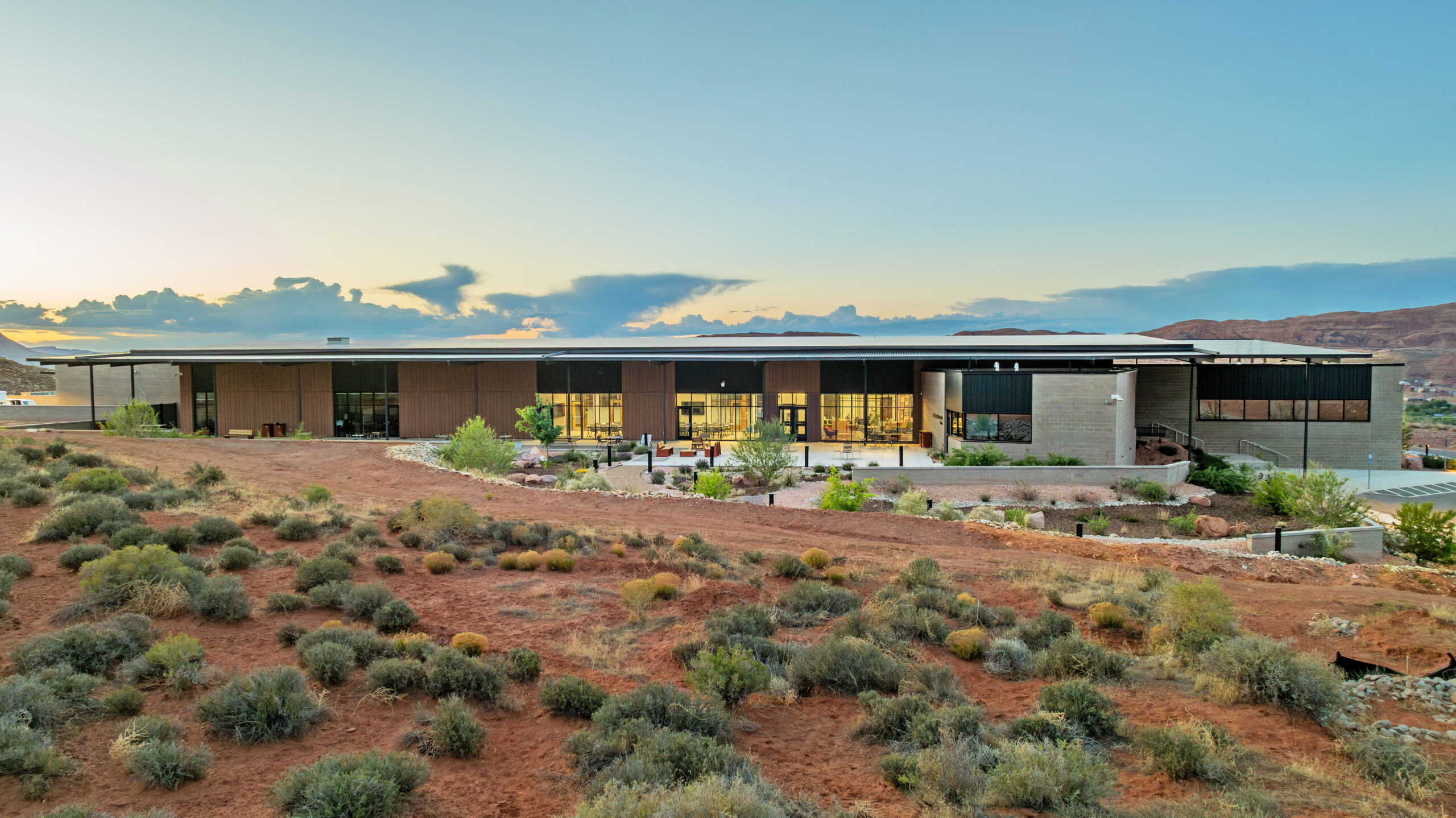
Photo: KIMBERLY MANZANO
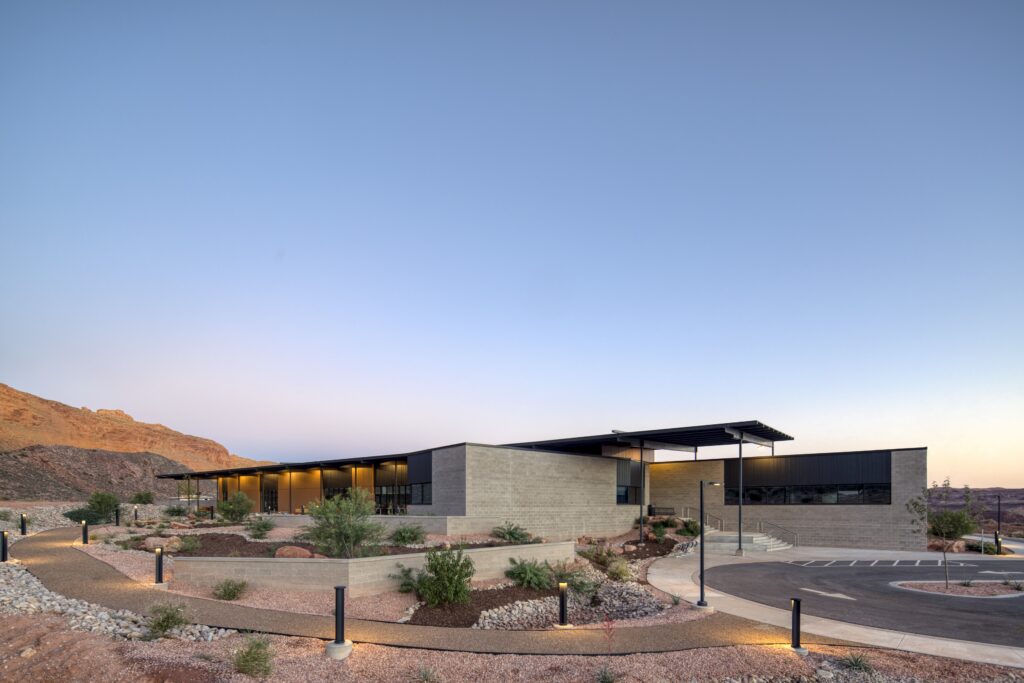
Situated at the base of the Moab Rim, the new Utah State University Moab Academic Building aspires to set a new standard of sustainable development on the Colorado Plateau by implementing passive design strategies, low-energy consumption, and high-performance systems. Designed to embrace the desert landscape and touch lightly upon the land, this educational facility is home to classrooms, labs, career and technical education (CTE) shops, administration/ faculty offices, student collaboration spaces, 4-H programs for children and adults, and local community functions. A large floating roof creates a series of outdoor rooms that celebrate place and a sense of campus within one building.
Project Team
| Architect of Record | MHTN Architects |
| Green Building Consultant | Lake | Flato Architects |
| General Contractor | Hogan & Associates Construction |
| Mechanical Engineer | Colvin Associates |
| Electrical Engineer | Spectrum Engineering |
| Plumbing Engineer | Colvin Associates |
| Civil Engineer | Civil Solutions Group |
| Envelope Consultant | UNVC |
| Structural Engineer | Reaveley Engineers & Associates |
| Interior Designer | MHTN Architects |
| Landscape Consultant | MHTN Architects |
| Geothermal Designer | Sound Geothermal Group |
| Energy Modeler | ETC Group |
Early Design Process
From the project’s inception, the Utah State University Moab Academic Building aspired to set an example of sustainable development in the region. It was critical to assemble a team that not only understood the values of the University but was also able to deliver on holistic performance with a constrained budget on a sensitive and challenging site. Salt Lake City-based MHTN Architects, with deep ties to USU over its 100-year life, partnered with sustainable visionaries, Lake | Flato, sustainably minded engineers at Colvin Engineering and Spectrum Engineers, and legacy Utah contractors, Hogan Construction, and began brainstorming possibilities.
The design team collaborated with an envelope consultant, soils and permaculture specialists, along with the CM/GC to conceptualize potential scenarios along with real-time cost impacts starting as early as interview-preparation through predesign and programming. USU requires all new buildings to be certified LEED Silver at a minimum, but it became clear early on that the aspirational goals for the project were more in alignment with Living Building Challenge.
Less than nine inches of water per year meant that the net zero water requirement of an LBC building would prove to be challenging to achieve. The architectural team initially recommended LBC Petal Certification in Energy, Equity, and Beauty. Various combinations of framework certifications were studied in terms of costs, process, and best fit. Ultimately, the team recognized that the goals of the project were best aligned with a path that capitalized on the project’s focus on energy performance and renewable energy production, which included LEED and ILFI Zero Energy certifications.
Once this decision was made, the design team and owner rallied around the framework requirements. The thresholds and requirements of certification were communicated to the team and consultants, and progress was reviewed at the beginning of all meetings. Because this decision was made relatively early-on in the design process, it aligned the team and brought clarity and specificity to goals of the project.
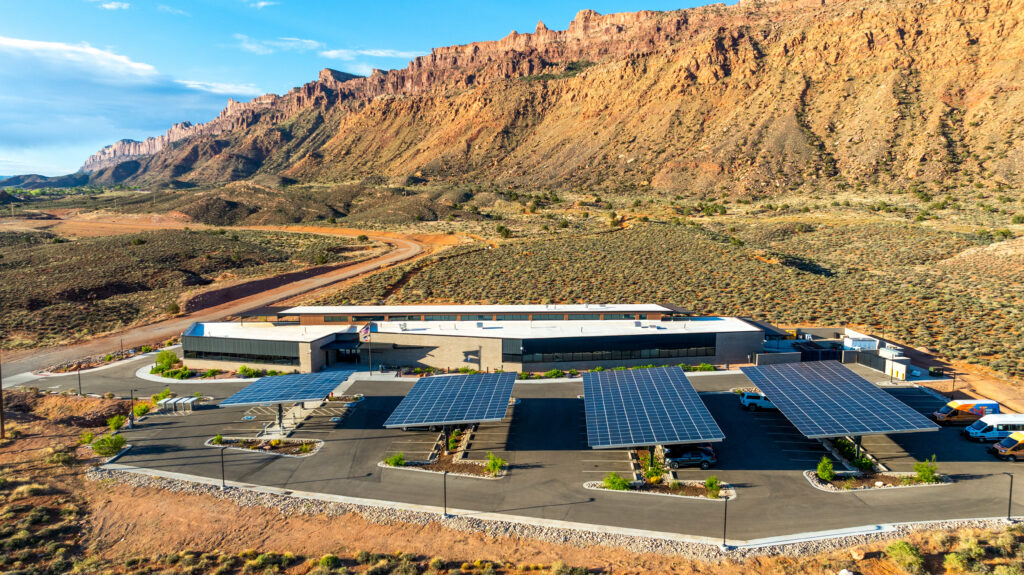
Photo: KIMBERLY MaNZANO
Construction
Although the goals of the project were clearly articulated and the team was in alignment, there was a point during the Project, when design was complete and the construction documents were being produced, that the client, Utah State University, had decided to pursue a grant for the solar array. The solar array, a key component that both the LEED and ILFI Zero Energy certifications hinged on, was taken out of the scope of the Project and became a separate project.
To mitigate any misunderstandings of the purpose of the array, the design team provided bridging documents that communicated the design intent, the minimum energy production requirements and emphasized the critical performance indicators. It was decided to require the solar array to produce 10% over the predicted power consumption of the building, slightly over the minimum 5% threshold to ensure ILFI ZE requirements would be met. To monitor progress and stay aware of issues, certification frameworks were discussed at the beginning of all the owner-architect-contractor meetings. A live document was maintained and updated that tallied all LEED and ILFI ZE items and identified any barriers or issues as they came up. The accuracy of the predicted use and occupancy of the Project was routinely tested and discussed between the design team and owner as it was critical to have a clear picture of the actual energy consumption of the building.
Ultimately, the integrative approach and consensus built across the stakeholder group and design team developed the shared vision and trust needed to execute and accomplish the goals of the project. The contractor involvement during the design process was critical and ensured that there was an understanding that the sustainability and performance of the project were directly tied to the success of the project. Continuous communication about and reiteration of the goals and paths to meeting them ensured the requirements were met.

Photo: Paul Richer. Copyright © 2022 All Rights Reserved. Paul Richer / Richer Images
Lessons Learned
There are several lessons the design team learned over the course of the Project that would have made the process of achieving certification more streamlined including: avoiding an undeveloped site, the timing of certification documentation, and the creation of a team agreement.
During the Project outset, the USU Moab Academic Building was considered the first building on a new campus. The large site, somewhat disconnected from the city of Moab, was selected for its scenic views and its ability to accommodate an expanding campus in the future. The site did not, however, have developed utilities including water and electricity, the costs of which were born on the Project. If the project were located in a previously developed site, it would have had more access to utility connections, transit, and the greater community, not to mention, make more certification framework credits accessible.
A simple practice that any team embarking on a certification process would be to begin documentation as early as possible, even concurrently with construction documents. The fresher the project is in the minds of the team, the more efficiently documentation can be completed. As time passes and the design team, consultants, and owner move onto other projects, the more challenging it becomes to engage team members and articulate the Project’s story. Understanding all documentation requirements early on, scheduling the documentation effort concurrently or directly after construction documents and communicating that intent to the team is critical.
One simple document that would have been extremely beneficial to this project because of its aspirational sustainability goals, is a Team Agreement. This would have served as a place to articulate in clear, concise terms the goals of the project available to anyone that is brought onto the project during later phases. Shared with the contractor and all relevant subs, this Team Agreement would be a way to orient those unfamiliar with the Project to the “what” and the “why”. We plan to implement this practice on all projects moving forward.

PHOTO: Paul Richer. Copyright © 2022 All Rights Reserved. Paul Richer / Richer Images
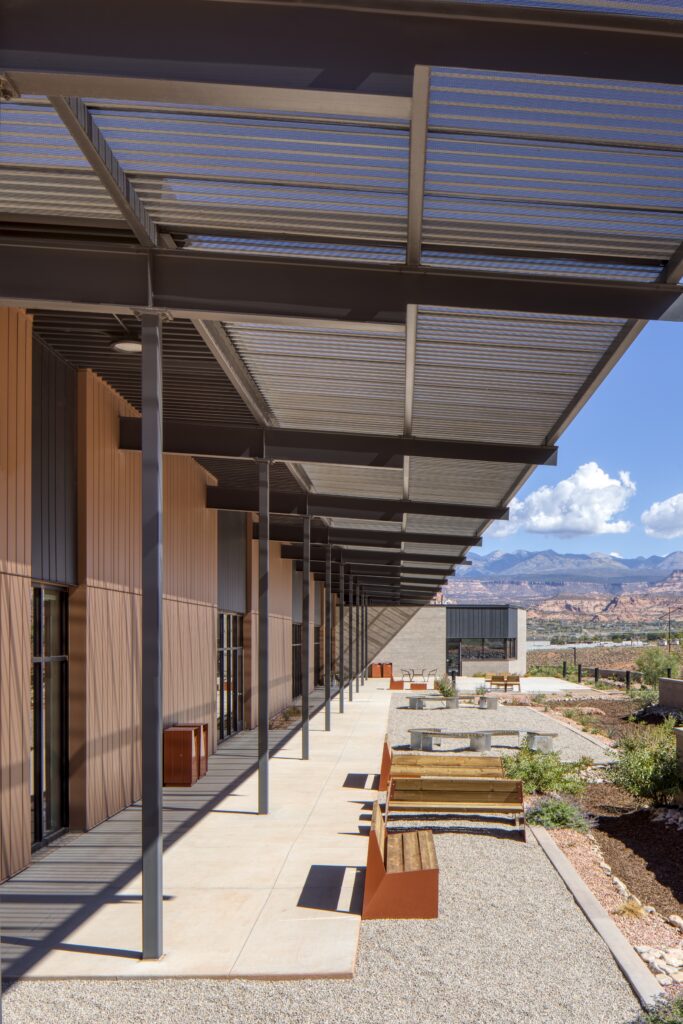
Photo: Paul Richer. Copyright © 2022 All Rights Reserved. Paul Richer / Richer Images