
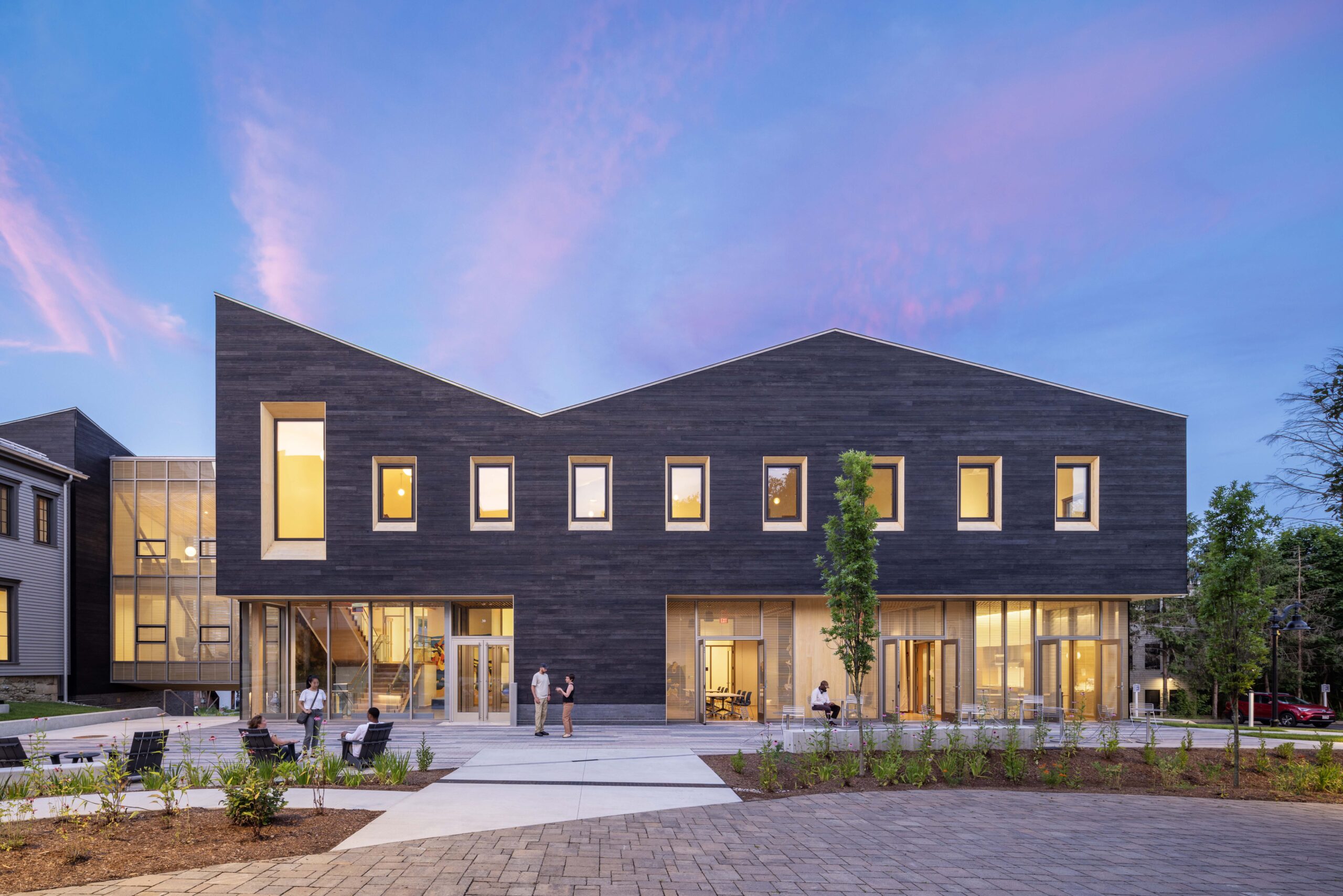
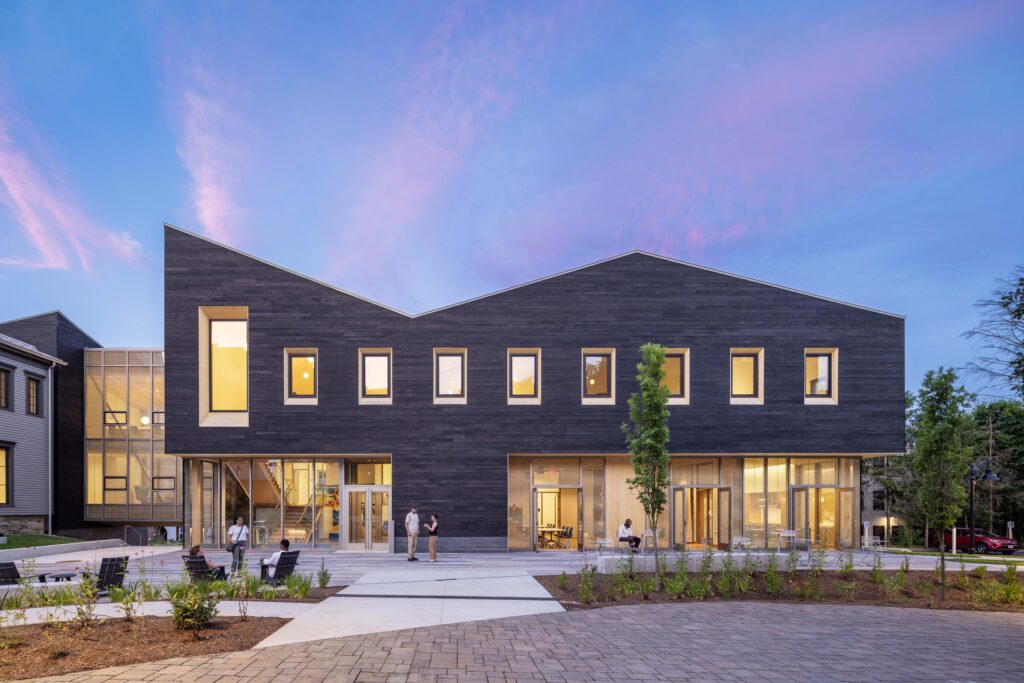
When the project was initiated in 2019, the Davis Center occupied 3 separate buildings (Rice, Hardy, and Jenness Houses), all converted from single-family homes. An unoccupied fourth residential building – Chandler House – sat at the far southern edge of the site. These buildings represented the remains of a once-residential neighborhood that had slowly been converted to academic use by Williams College over the last 100 years, and whose scale was increasingly dominated by large science-oriented classroom and laboratory buildings. Both Rice House and Jenness House had been moved to this location from other sites to accommodate new Williams academic buildings. The design approach sought to balance renovation/reuse of the existing buildings with a new addition that housed the larger community gathering spaces needed to support Davis Center programming.
The project site is bounded by an existing parking lot to the north and by Walden Street to the south. Morley Circle – a paved fire lane – defined the western edge, and a hammerhead fire access lane defined the eastern edge. The site had significant elevation changes – 10’ E-W and more than 30’ N-S. The site strategy sought to enhance pedestrian movement, improve permeability, increase biodiversity and plant health, and design for resilience and user appreciation.
I01: Limits to Growth
Connections with Nature and Place:
Throughout the landscape, native trees and plantings are coupled with adapted species, creating a diversity of planting that enriches the local ecology and reflects the mission of the Davis Center. Planting was designed to increase biodiversity and plant health, eliminate potable water for irrigation, to increase resilience and for user appreciation. Planting impacts exterior microclimates, diffuses urban heat islands, and reduces reliance upon mechanical climate control systems. Along with environmental benefits, the landscape facilitates novel community connections and provides space for maintaining physical and mental well-being. The planting is composed of a collection of specimen trees, flowering understory trees, a riverine bioswale, seeded meadows throughout, and turf lawn for gathering spaces.
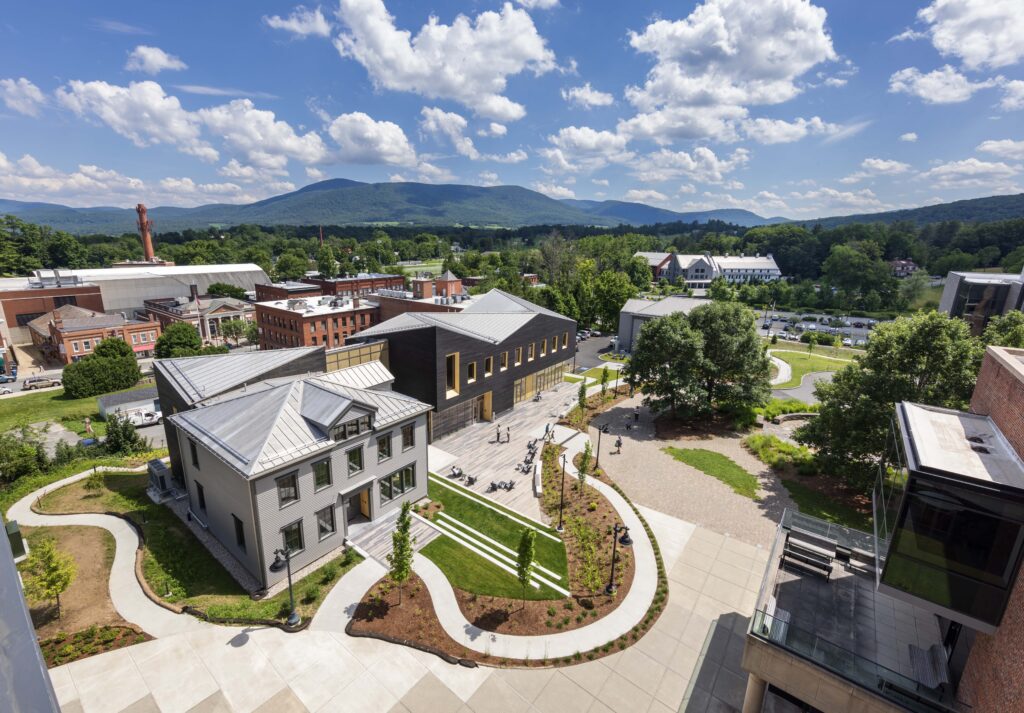
Tree selection was guided by the Davis Center’s mission, the College’s commitment to a diverse tree canopy, and rigorous community outreach. The White Oaks community in Williamstown had a high concentration of Black Residents. Through oral history the design team learned that this community once had beautiful white oak trees which have been incorporated into the final landscape design. Nonnative tree species will be functional, performative, educational, resilient, historically relevant, and visually pleasing throughout the year. These trees include the Princeton Sentry Maidenhair Tree, the Japanese Pagoda and the Turkish Filbert that reference the center’s mission of diversity.
The flowering understory trees provide an early spring scent and color.
Water and riverways were once integral to the minority communities of the area. As told by the Christian Register many ““squatted” on the banks of banks of Broad Brook, built shanties, and reared families under their former masters’ names.” In addition, Williams College’s landscape study highlights the project site for opportunities for surface stormwater treatment and detention including bioretention, wet meadows, and stream restoration. The proposed riverine bioswale provides both an ecological function and an important cultural reference for the users. The entire site is shedding water from paved and grass areas to the bioswale. The plants and specially designed soil profile work to retain, cleanse, and clean the water before it enters an underground recharge system at the former site of Chandler House. The plants selected for the bioswale can tolerate both wet and dry conditions. They are native species that also function as natural pollinators.
The woodland garden and meadow will support pollinators like butterflies, bees, and birds with blooming vegetation and sustenance that will facilitate a richer and more equitable campus ecology.
Overall landscape and planned plant communities provide educational opportunities through visibility, demonstration, and quantifiable performance. The landscape has been intentionally designed as an immersive teaching tool for the Davis Center, Williams College, and neighborhood, which makes visible landscape history, evolution, and performance
I07: Civilized Environment
Connections to the Natural Environment:
Operable windows in every room offer visual connections to the outdoor environment and direct occupant control. On the ground floor, the multipurpose/event space and community kitchen have doors that open out onto the patio beyond, creating an indoor/outdoor space for large community events. Along the upstairs corridor, major windows oriented to the north and south bring natural light deep into the interior and provide views to the mountain ranges beyond. At the bridge between Rice House and the addition, slatted wood louvers integrated into the glazing strike a balance between sweeping mountain views and student privacy, providing views out, but screening the occupants within.

I08: Healthy Interior Environment
Reducing Exposure to Volatile Organic Compounds:
Material selection sought to minimize occupants exposure to volatile organic compounds (VOCs), prioritizing products that met California Department of Public Health (CDPH) Standard v1.2-2017 for VOC emissions. The project considered the VOC content of wet-applied products as well, selecting products that met the VOC limits of the South Coast Air Quality Management District (SCAQMD) Rule 1168 for Adhesives and Sealants.
Promoting a Healthy Interior Environment:
MERV-13 filters trap and block up to 98% of particles as small as 0.3 microns. Exterior and interior walk-off mats at each entry help trap dust and particulate matter. Building materials have been carefully vetted to minimize volatile organic compounds. The Davis Center is cleaned with products that comply with the EPA Safer Choice guidelines.
I09: Biophilic Environment
This imperative is combined with Beauty & Spirit in LBC 4.0 – this project has taken a similar approach to integrate this with the Beauty Petal. Many of the enduring themes and core imagery that defined the Davis Center expansion emerged out of a dedicated Beauty and Biophilia Charrette with the committee and design team. All participants were asked to bring something – an image, a quote, a photo – that represented what the Davis Center meant to them, or what they hoped it could be. These shared stores and ideas captured a rich set of images, metaphors and values that continued to resonate throughout the design of the Davis Center.

I11: Embodied Carbon Footprint
The Davis Center is net zero embodied carbon. The total embodied carbon impact of its construction is accounted for and offset through a one-time purchase of carbon credits. Throughout the design phase, this project evaluated and incorporated strategies to reduce the embodied carbon footprint of the renovation and expansion of the Davis Center.
Adaptive Reuse of Existing Structures:
At the outset of the project, all four existing structures (Rice House, Hardy House, Jenness House, and Chander House) were evaluated for their potential to meet current and future needs of the Davis Center. the design team recommended a hybrid approach – preserving and renovating Rice House and Jenness House while demolishing Hardy House and Chandler House.
Structural Systems:
By using a glulam and light frame wood structural system instead of a steel frame with metal deck, we estimate that 112 MT of CO2 have been avoided, reducing the total embodied carbon footprint by 26%.
Exterior Wall Insulation:
By using mineral wool board insulation at the exterior walls instead of extruded polystyrene (XPS) insulation, this project reduced the total embodied carbon by 3%.
I15: Human Scale + Humane Places
This project reconfigures an existing parking lot and access road to create a united, pedestrian-oriented plaza between the buildings of the Davis Center precinct, while maintaining accessible parking and accessible van-drop-off.
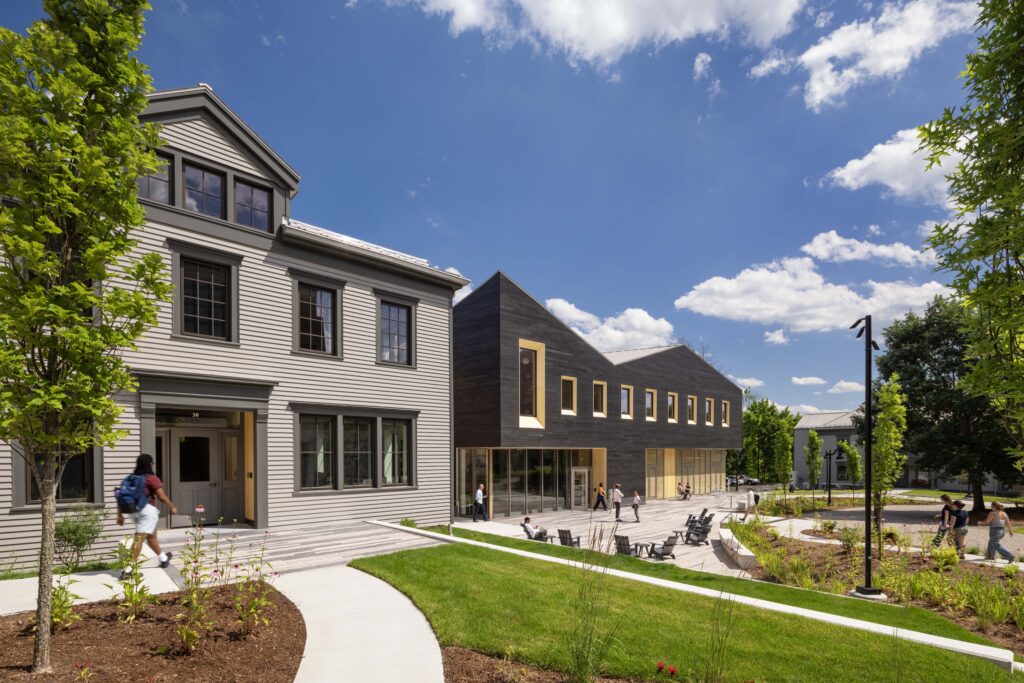
The overall scale of the addition is harmonious with the residential scale of the preserved Rice and Jenness Houses. The addition maintains a continuity of height, angled rooflines, and proportions of many of its windows. Larger openings are provided for gathering spaces appropriate to the institutional setting and program. All facades of the building have openings and all non-service areas have access to natural light.

The project incorporates multiple spaces for gathering and connection internally and with the campus and surrounding community. As a Center that “advances broad campus engagement with complex issues of identity, history, and cultures…” these spaces are integral to its mission. These include a Gender and Sexuality Resource Room, a multipurpose, flexible event space, living rooms, public dining rooms and kitchens, a quiet dining nook, multiple lounges, meeting rooms, a group study room, a Spirituality and Religion Reflection Room, and a Pathways to Inclusive Excellence Resource Room. Over 50% of the program is dedicated to gathering and connection spaces.
Within the landscape of the project, there are multiple areas for community gathering which promote the human-scaled environment of the surroundings.
This project creates a new, fully accessible connection from Walden Street from the south with a path that winds past the Jenness Celebration Lawn and Sitting Steps. The new celebration lawn provides a major new outdoor space for Davis Center gathering with an outlook to Mount Greylock in the distance.
A new pedestrian-oriented tabletop at Morley Drive connects to a plaza at the heart of the Davis Center beyond. The plaza invites interaction at its edges with built-in benches that line the riverine bioswale. A series of sitting steps navigate the grade change up to Rice House, creating an informal outdoor for teaching and gathering.
A new lower-level entry opens onto Bank Street, helping extend accessible paths through campus and creating a visible Davis Center frontage and public-facing connection to Williamstown’s main commercial street.
I16: Universal Access to Nature + Place
Walden Street Path
On Williams’ beautiful, hilly campus, making physical connections fully accessible is a challenge. This project creates a new, fully accessible connection to Walden Street with a new path that winds past the Jenness South Lawn, crosses a new pedestrian-oriented tabletop at Morley Drive, and connects to the heart of the Davis Center beyond.
Universal Design
Throughout the Davis Center, each entry is designed to welcome all people through the same front door, along the same path of travel. Within the Rice House and addition, a central stair and elevator are immediately visible from the Morley Circle and Bank Street entry, ensuring that users of different physical abilities are able to travel freely to all floors. “Accessibility” frequently focuses on physical access. This project sought to expand the definition of accessibility with spaces that expand cultural access as well.

Religion, Reflection, Spirituality, & Ablution:
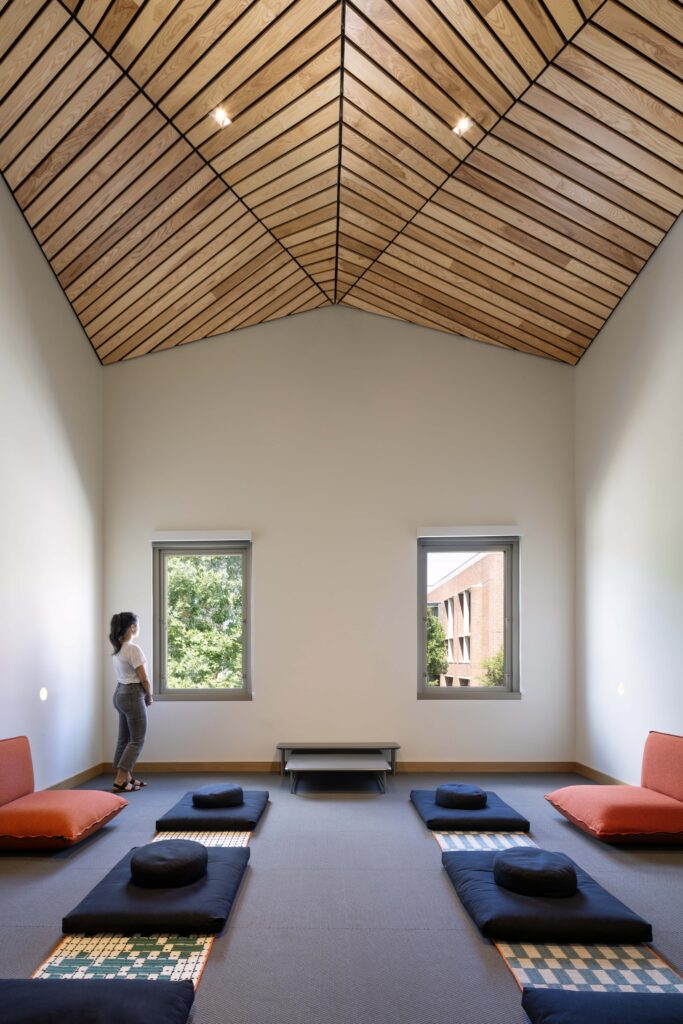
The Davis Center has a dedicated space to celebrate religious practice, personal reflection, and holistic spirituality. The folding planes of the roofscape above give the wood ceiling a unique geometry and focused energy. The space supports a wide range of devotional practices, with a dedicated refrigerator for perishable food or flower offerings, an adjacent ablution space to enable ritual cleansing, and storage for prayer mats.
Bathroom Access:
The need for a bathroom is universal. Every toilet room throughout the Davis Center is designed as all-gender and fully accessible.
Food is Culture:
Cooking food and sharing meals has always been an important part of the Davis Center community. The kitchen spaces are detailed to seamlessly integrate accessible use and eliminate physical barriers throughout, with careful attention to reach ranges, floor clearances, and operability. The Community Kitchen supports meals at different scales and levels of intimacy – from the cozy booth-style dining nook, to the large kitchen table for shared meals, to serving as a catering kitchen for larger community celebrations in the adjacent multipurpose event space. The electric cooktops were intentionally selected to support the use of any pots and pans – ensuring that food could be cooked in traditional or heritage cookware.

I17: Equitable Investment
The Davis Center is owned by Williams College, a registered 501(c)(3) nonprofit organization. Per exception I17-E1, the project is exempt from the requirements of Imperative 17 Equitable Investment due to this classification.
I18: JUST Organization
Beyond creating spaces that support equitable use, this project created stable, safe, and high-paying job opportunities for people in the local community, and supported local, diverse businesses through hiring, purchasing, and workforce development practices. The design team included two JUST labeled organizations – Leers Weinzapfel Associates Architects (architecture) and Materially Better, formerly Integrated Eco Strategy (sustainability).
The Davis Center renovation and expansion sought to support minority- and women-owned businesses in both design and construction. The design team was led by Leers Weinzapfel Associates Architects (WBE), with J. Garland Architecture + Design (MBE), RSE Associates (MBE), and Nitsch Engineering (WBE). The construction team achieved 1.9% MBE and 28.3% WBE firm participation, as well as 23.3% minority workforce and 2.8% women workforce participation.
I19: Beauty + Spirit
The renovation and expansion of the Davis Center is part of a broader vision for the future of Williams College, to make sure all students thrive academically at Williams and beyond, through opportunities and programs that work to eradicate racial and socio-economic disparities in higher education.
The renovation and expansion of the Davis Center was designed with deep and sustained community input. It began with a series of open campus workshops, seeking direct student input on the successes/shortcomings of the existing Davis Center spaces and the needs of Minority Coalition (MinCo) student groups.
A Design/Biophilia Charrette created an opportunity for community co-creation and integration of local culture, history and values. These shared stories and ideas captured a rich set of images, metaphors and values that continued to resonate throughout the design of the Davis Center.
Preserving Rice House
“Rice House is a part of the legacy of Black student activism at the College.” – Rocky Douglas, Black Student Union (BSU)
This commitment to maintaining Rice House as a dedicated Black was based on a consensus-building decision model with every building committee member – faculty, staff, student, design team – speaking to share their observations, hopes and fears. Although the new wing attaches directly to Rice House, the design sought to maintain the integrity of Rice House as a coherent space – connected to the broader complex, but with a distinct identity.
White Oaks
“White Oaks – where my Black ancestors found refuge – that’s where Black roots in Williams started.” – Bilal Ansari, Co-Director of the Davis Center
The material and craft traditions of the White Oaks community – the oldest minority community in the area, founded by self-emancipated slaves – became a key inspiration for the material palette, focused on integrating white oak wood and basketry-inspired forms, along with an intentional incorporation of gleaned / salvaged materials.
Charred Wood
The new wing of the Davis Center is clad in charred wood, using a traditional Japanese technique called shou sugi ban that preserves wood using a technique of controlled, partial burning. For the Davis Center community, this charring process symbolizes and celebrates the resilience of minority communities in the face of adversity.

Memory and Murals
Throughout the Davis Center, original artwork honors the memory of communities that have been displaced and spaces that have been erased. Two main social and gathering spaces — the renovated Rice Living Room and new Multipurpose/Event Space — feature murals that recreate and reinterpret the Mears House Mural, originally painted in 1969 by student artist Jerome Meadows to celebrate the campus’ first dedicated Black space. Spanning three stories at the central stair, an original mural by Meleko Mokgosi ’07 memorializes Sand Spring, a local site sacred to the displaced indigenous Stockbridge-Munsee community. At the top of the central stair, Faith Ringgold’s quilt “100 Years at Williams College, 1889-1989” looks out over a sunny sitting spot. This narrative work of fiber art was commissioned in 1989 to celebrate the centennial anniversary of Williams first Black graduate, Gaius C. Bolin.
I20: Inspiration + Education
As an educational institution, Williams College is dedicated to ongoing learning. With each new class of students welcomed on campus, the Davis Center will be discovered anew.
The Davis Center staff and student peer advisors have already put into place a framework to introduce new users to the building. A “self-guided scavenger hunt” flier was distributed to students and alumni as part of the April 2024 Bolin Legacy Mentorship Weekend and Davis Center Reopening Celebration. This scavenger hunt builds upon the themes and imagery developed through the Biophilic Framework and Plan, recognizing moments of beauty, spirit of place and celebration of culture embedded in the Davis Center project.
As part of the commitment to the Living Building Challenge, the Davis Center will host an annual open house event designed to introduce the public to the project. Permanent installed signage highlights the sustainable features of each petal imperative. Upon Living Building Challenge certification, a Davis Center case study will be included in the International Living Future Institute’s website (ILFI) to share the lessons learned with future projects.
Williams College also publishes transparent, real-time energy use data about its buildings on its sustainability website. As they note:
“The college’s greatest contribution to society and sustainability is through educating students so that they can be engaged citizens, change-makers, and thoughtful contributors to a more sustainable world. We do this through our teaching, research, and co-curricular offerings, and by implementing sustainable practices in campus operations.”
