

The Red List
About the Red List
The Living Building Challenge Red List identifies the “worst-in-class” chemicals for human health and the environment that are commonly found in building products.
The Red List helps manufacturers, designers, and building teams make more informed material choices and is used across Living Future programs, including the Living Building Challenge, Living Product Challenge, and Declare.
Its goal is to help drive the transition toward healthier materials by encouraging the elimination of chemicals of concern and the development of safer alternatives.
What’s on the Red List?
The Red List includes chemicals and chemical classes associated with serious human health or environmental concerns. They are found in a wide range of building products and may serve functions such as flame retardants, plasticizers, preservatives, solvents, and more.
The Red List is organized by chemical class, and individual chemicals are identified by their CAS Registry Number (CASRN).
The current Red List includes the following chemical classes:
| Antimicrobials (marketed with a health claim) |
| Alkylphenols and related compounds |
| Asbestos compounds |
| Bisphenol A (BPA) and structural analogues |
| California-banned solvents |
Chlorinated Polymers, including:
|
| Chlorobenzenes |
| Chlorofluorocarbons (CFCs) and hydrochlorofluorocarbons (HCFCs) |
| Formaldehyde (added) |
| Monomeric, polymeric, and organophosphate halogenated flame retardants (HFRs) |
| Organotin Compounds |
| Perfluorinated and Polyfluorinated Alkyl Substances (PFAS) / Perfluorinated Compounds (PFCs) |
| Phthalates (orthophthalates) |
| Polychlorinated biphenyls (PCBs) |
| Polycyclic aromatic hydrocarbons (PAHs) |
| Short-chain and medium-chain chlorinated paraffins |
Toxic heavy metals:
|
| Volatile organic compounds (VOCs) in wet- applied products1 |
| Wood treatments containing creosote or pentachlorophenol |
A Class-based Approach
The Red List takes a chemical-class approach rather than looking only at individual chemicals. This helps reduce the risk of “regrettable substitution”—replacing one chemical of concern with a closely related chemical that presents similar hazards.
Red, Priority & Watch Lists
Three Levels of Consideration
Living Future uses three levels to signal where a chemical or chemical class is in the review process.
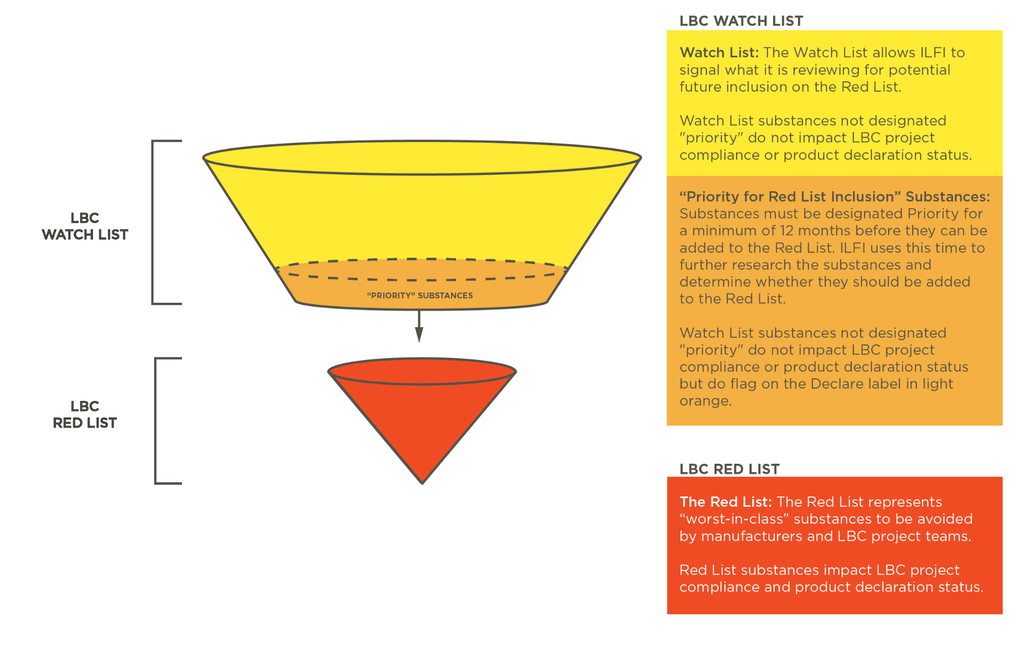
Watch
Signals that Living Future is researching a chemical or chemical class for possible future inclusion.
Priority
Signals that Living Future is actively considering the chemical or class for future Red List inclusion. Chemicals generally remain on the Priority List for at least 12 months before advancing to Red.
Red
Chemicals and chemical classes included in the current Red List and subject to applicable Living Future program requirements.
Movement between the lists is not necessarily one-way. A chemical may move back to an earlier stage as research and technical review evolve.
The Watch and Priority List chemicals do not by themselves affect a product’s Declare status or its use in an LBC project.
How the Red List Changes
The Red List is periodically updated as new scientific evidence becomes available, regulations evolve, and Living Future’s technical advisors and stakeholders provide new information.
How do Red List Updates Affect Products and Projects?
Red List updates can affect Declare labels and Living Building Challenge projects differently, depending on when a product is evaluated or specified. Living Future provides specific guidance for manufacturers and project teams.
Explore the Red List
What’s on the Red, Priority, and Watch Lists now?
Why are these chemicals included?
How does Living Future evaluate and update the Lists?
What has changed over time?
Have a Question or Want to Get Involved?
Questions about a chemical or chemical class? Email declare.support@living-future.org.
Want to help inform future Red List updates? Learn about the Material Health Technical Advisory Group or email tech.advisory@living-future.org.